
AI tools are widely used in real life, and trip planning is no exception. For many travelers, planning a trip is the most challenging thing, so more and more people try travel planning with AI. But in real use, there are always unexpected issues, such as itineraries that are not personalized enough or information that isn’t accurate.
Is AI good for travel planning? AI tools do make mistakes, and there’s still plenty of room for improvement. But if you use it correctly, an AI travel planning tool can be your most capable assistant, saving you from endless information. As an experienced traveler, I have tried almost all of the AI tools and summarized 15 things to know before using the AI trip planner to share with you in this article. What's more, I'll share a prompt that I usually use at the end of the article.
15 Things I Learned After Using AI for Trip Planning
1). AI doesn't work well for travelers without a clear goal
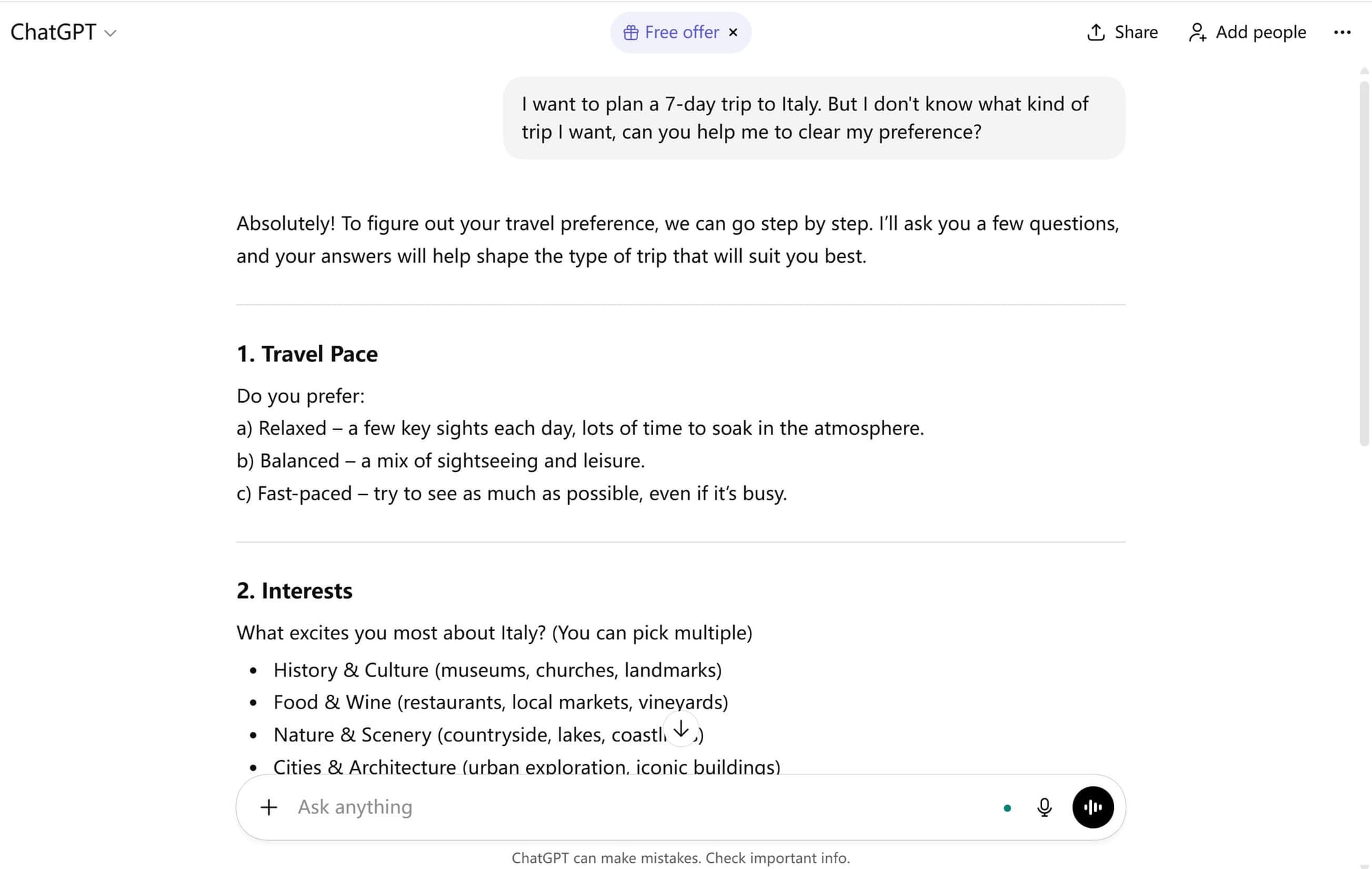
Before using AI trip planners, you should have a clear goal first. I tried using an AI trip planner to plan a seven-day trip without a clear destination. It generated several itineraries for me, but none of them is exactly what I want. If you don't have clear goals, you can use tools like ChatGPT for brainstorming first, then turn those ideas into clear and detailed requirements for a dedicated AI trip planner.
2). AI can’t guess your preferences
The more precisely you input, the more personalized your itinerary will be. Or the AI will assume your preferences, which may not match what you actually want. I once planned to go to Hawaii for local outdoor activities, but because of my simple prompt, I got an itinerary full of activities in the "top things to do" list. Thus, provide detailed prompts with your interests and priorities.
3). AI doesn’t know the energy levels of travelers
AI can estimate travelers' conditions based on the information you provided, like age and relationship, but it can't assume the exact energy level of travelers. That is what I realized during the trip in Australia with my cousin, who is 1 year younger than me, but has lower stamina. He almost broke down after several days of outdoor activities. Thus, don't just tell AI the age of the travelers, say "two 30 males, one with lower stamina, do not arrange high-intensity outdoor activities on consecutive days."
4). AI can be over-focused
I told AI that I like "coffee and art." It planned many related activities for me. But too much, more than I expected, resulting in a lot of repetitive experience. You'd better set limits on your preferences, like "3–5 different coffee and art activities for one destination."
5). AI may hallucinate when planning trips
This is the biggest problem I found with AI trip planning mistakes. Some AI trip planners, based on Large Language Models (LLMs) and a single API, lack the ability to verify real-time information, which can lead to AI hallucination. It's so bad to be taken to a restaurant that has permanently closed when you are starving. So, do check the information that AI gives you before the trip. In addition, choose a more reliable tool for AI trip planning with stronger web search capabilities and a multi-source database. If you are curious about how to minimize AI hallucination, read this post.
6). AI can plan routes, but may not understand your vibe
For example, I told AI that I like a historical vibe, and I got an itinerary with lots of visits to museums. But what I really want to experience is historical remnants or old neighborhoods with abandoned rails embedded in cobblestone and traces of hooks on old buildings. Thus, for unique activities you want to experience, you'd better list them first and then let AI help you generate a reasonable route.
7). Do give AI clear dates
AI is sensitive to timing, and wrong or unclear dates can ruin the itinerary. I used to input the information like this: "I want to plan a 5-day trip to Paris on July 6." More often than not, I got a 7-day itinerary, with the departure and return days counted separately. So, I make it more precise by input: "I want to plan a 5-day trip to Paris, departing from London on July 10 and returning to London City on July 14."
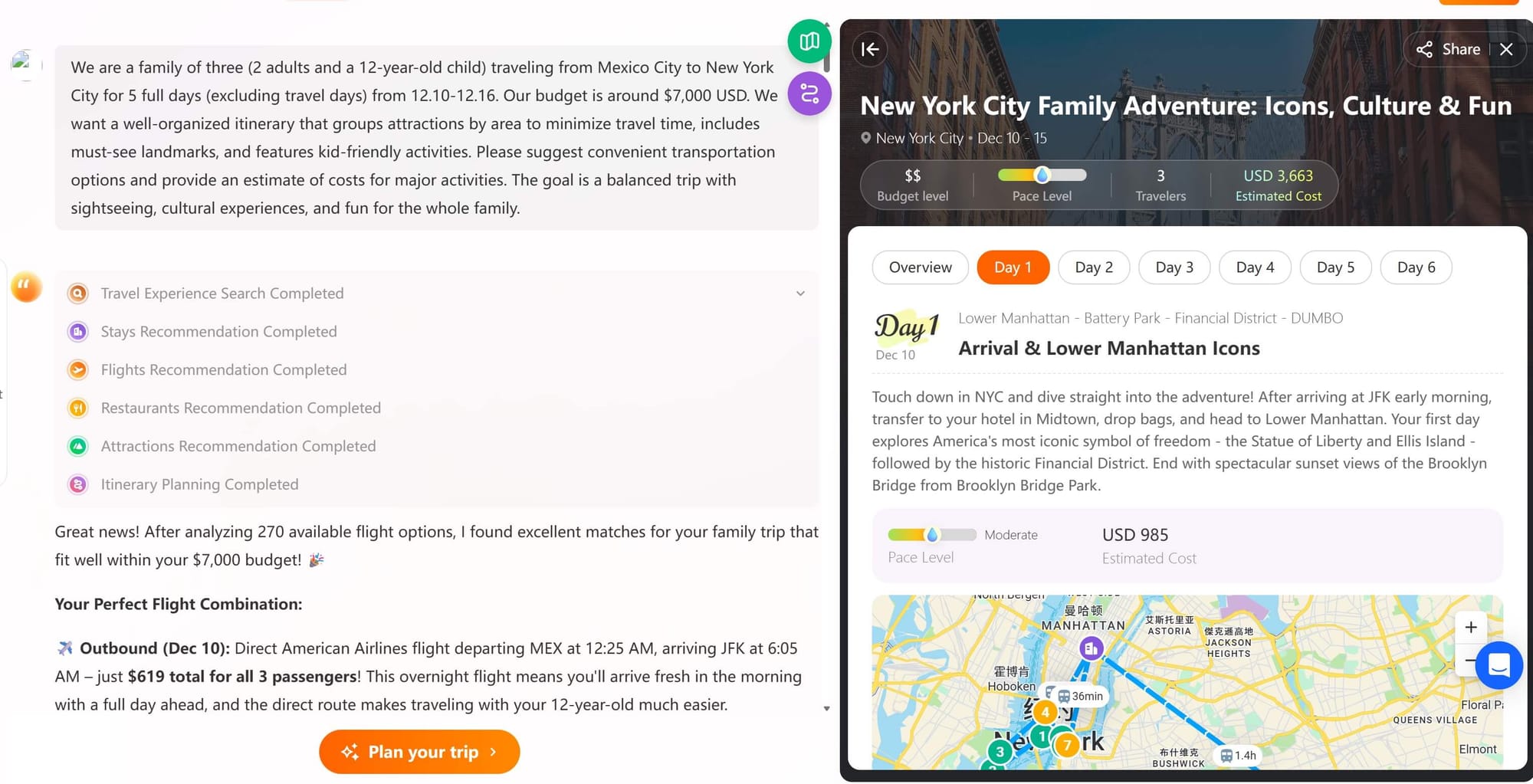
8). AI may miss real-time information
We said that LLM may lead to AI hallucination, and the biggest reason is the lack of real-time information. Some AI tools are not connected to real-time flight and hotel systems, so they even recommend flights or hotels that don’t actually exist. Thus, AI trip planners that integrate more real-time sources are more reliable.
9). AI can’t make decisions for your personalized itinerary
I once recommended an AI trip planner to my friend, but after the trip, he told me that he didn’t enjoy the itinerary at all. Can AI really plan a trip? When I asked why, I realized that he had completely let the AI make all the decisions. Travel pace? Activities? Preferences? All recommended by AI. AI can provide recommendations, but a personalized itinerary is based on the decisions you made, tailored to your pace and preferences.
10). AI can’t lock real-time prices
For AI tools that can search and compare flight, hotel, or ticket prices, they cann't lock in the real-time prices. Sometimes the prices you see may not be the prices you finally get, as they can change due to demand, time, or other factors. So, if you get a good price, book it as soon as possible.
11). AI tools differ in hotel and flight search
Some AI tools may be more powerful at searching for flights, while others may do a better job with hotels. And many AI tools don’t even have real-time booking integration or availability data, and may provide false information. Thus, don’t trust it blindly for the info. It's better to verify the information across different tools and use tools that link directly to the booking pages.
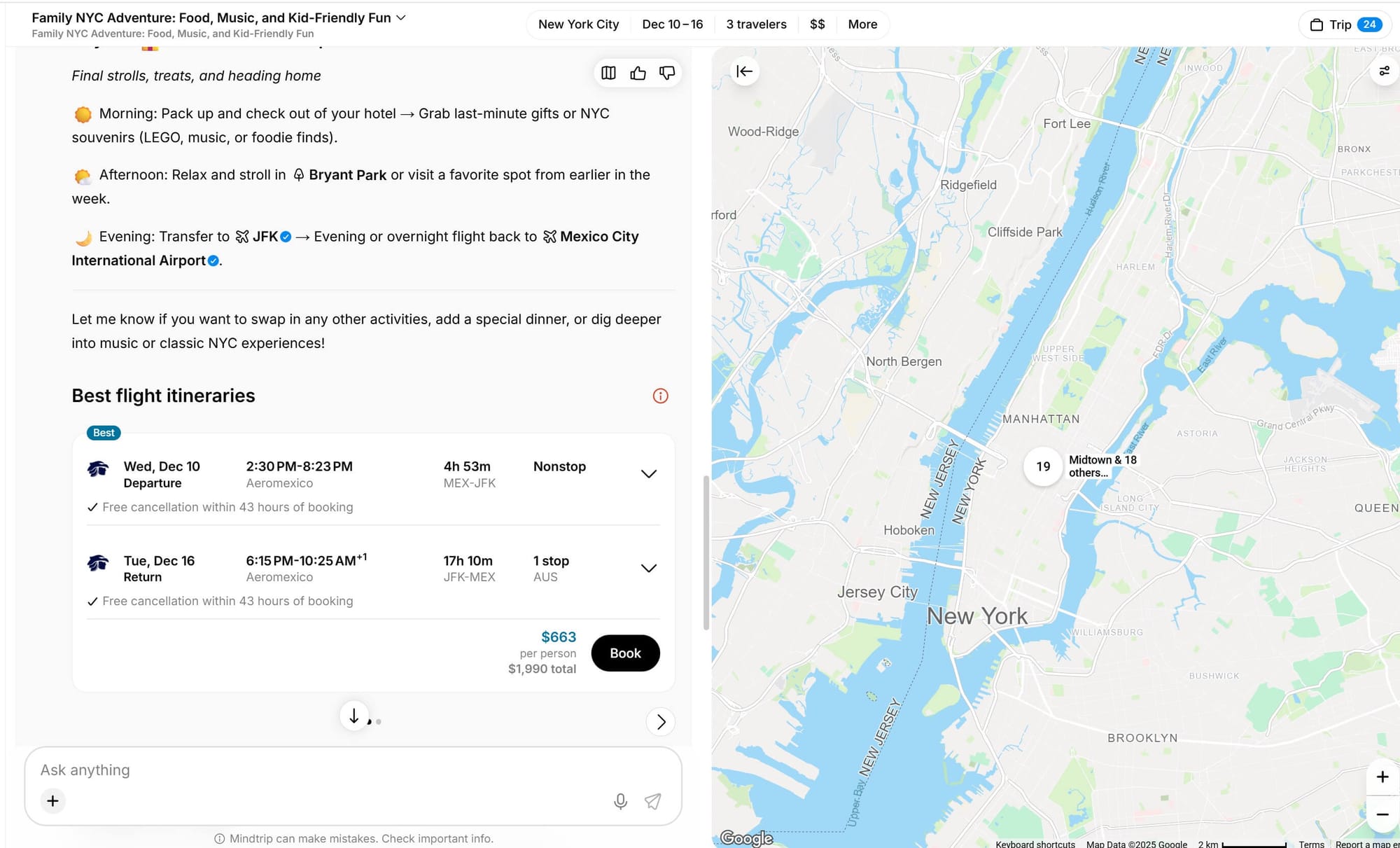
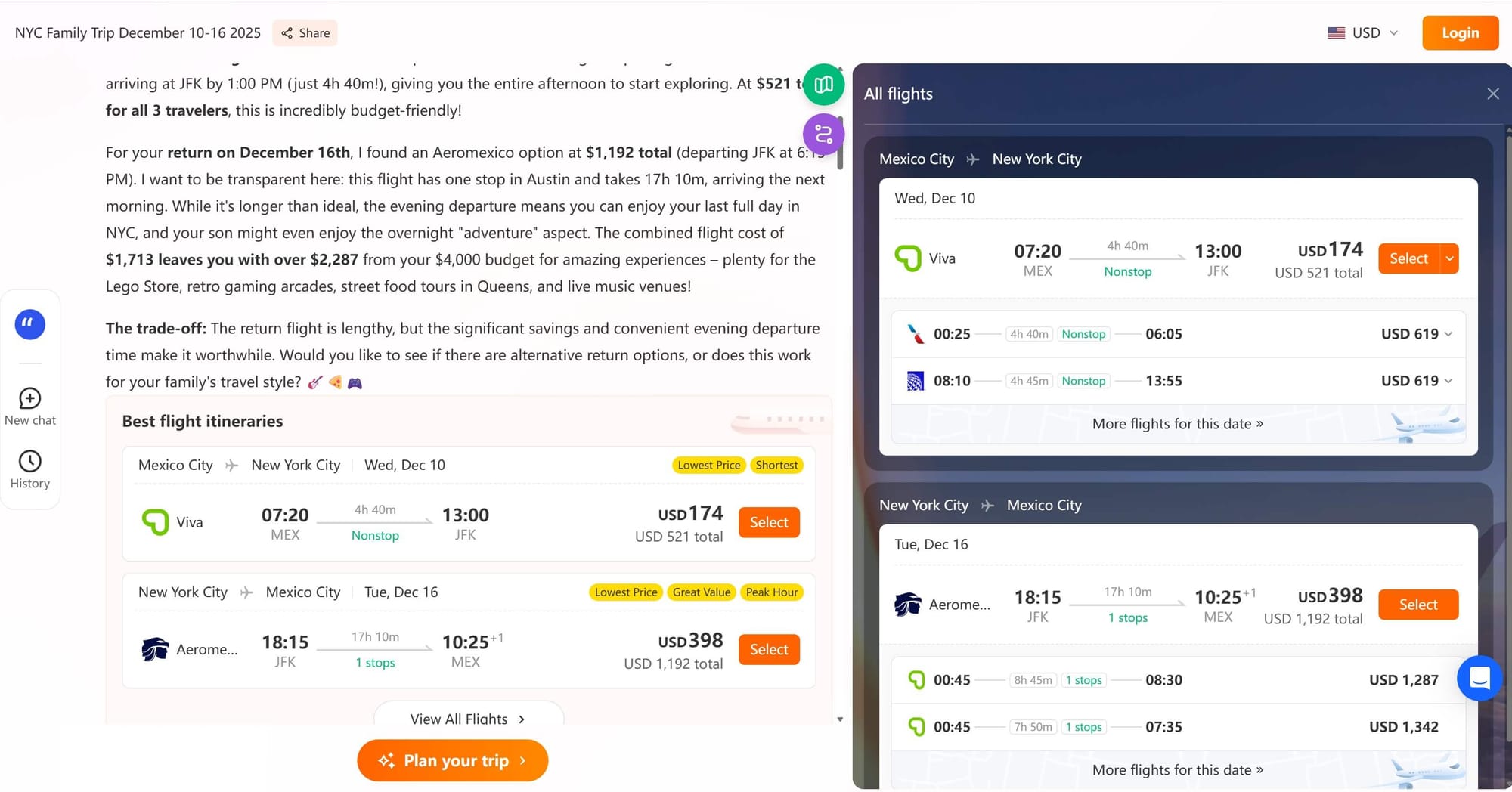
12). Tell AI your preferences for flights and hotels
Based on my experience, AI trip planners always recommended the most economical flights or hotel options. But sometimes, I'd like to spend more money to get to my destination earlier rather than endure a flight with a 10-hour layover. And for hotels, I prefer hostels close to the city center rather than single rooms farther away. So tell the AI your exact preference for better recommendations.
13). Leave some flexibility in your AI itinerary
Leave some time in your itinerary for unexpected exploration. I used to spend a lot of time and energy generating an "ideal" itinerary. But there are always situations that AI cannot predict, and my trip doesn’t always follow the itinerary. And now, I will leave some time for unexpected situations or spontaneous exploration. I have to say, it not only saves my energy, but also brings me more surprises.
14). AI may overlook hidden costs when estimating your budget
Some AI tools have the ability to estimate the budget, which is fantastic. But they often overlook hidden costs like luggage storage fees, tips, and innercity transportation costs. So, you'd better re-estimate the budget and prepare enough money for hidden costs during the trip.
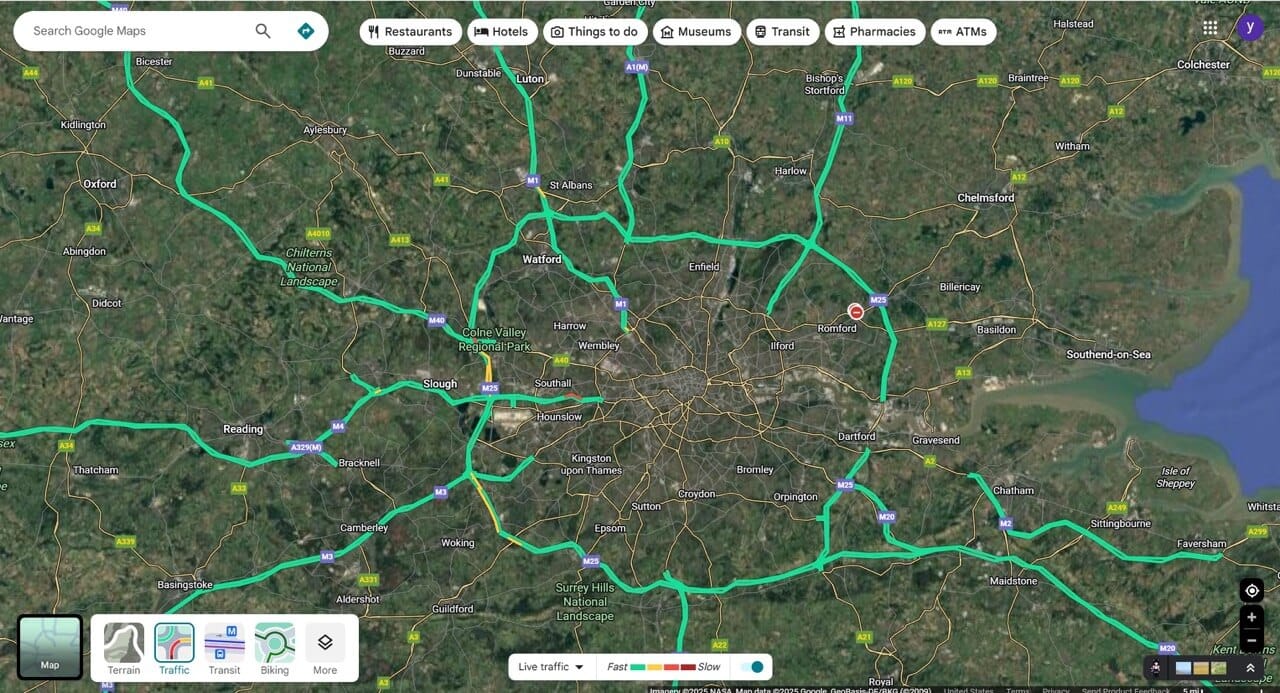
15). AI may be weak at planning local transportation
The local transportation could be too complex for an AI to plan. For central areas, walking can be more convenient than taking the subway. For attractions a bit farther away, the subway can be more economical than taking a taxi. How to choose depends more on the city's traffic conditions and the travelers’ needs. So, you can download Google Maps or the city's popular map app for more reliable information.
Final Thought
Using AI to plan a trip is really about saving time and reducing the endless search for information, although there are common mistakes using AI for travel planning that AI often makes. It gives you a responsive draft to work from, not a tool that makes every decision for you. When used properly with the AI travel planning tips, the experience can be completely different. My favorite AI trip planner is iMean AI, because in my experience, it produces the fewest mistakes and hallucinations. By combining a web agent, reasoning framework, multi-source data, and human-in-the-loop, it significantly reduces errors and delivers more reliable travel plans.
Try It Yourself — Sample Prompt
I would like to plan a trip for [number of travelers] [gender/description] with a budget of around [budget] per person. The trip will last [number of days] days at a [slow/moderate/fast] pace. We plan to spend [number of days] in City 1, [number of days] in City 2, …, and [number of days] in City N. We will depart from [departure city] on [departure date] and return to [return city] on [return date]. Additional notes: [friends joining, special events, or preferences like girls’ night out, outdoor activities, food experiences]. Please help me plan the trip.