The category also changed noticeably in 2026. Expedia acquired Layla, Mindtrip expanded its destination partnerships, GuideGeek moved closer to real-time booking, and GPT-6 Astra gave ChatGPT new relevance for complex travel research.
The best tool still depends on what you need. Some products focus on inspiration, while others are stronger at maps, collaboration, flights, hotels, or day-by-day itinerary management.
Here are eight AI trip planners worth considering in 2026.
Quick Comparison
| AI trip planner | Best for | Main strength |
|---|---|---|
| iMean AI | All-in-one travel planning | Flights, hotels, personalized itineraries, and destination discovery |
| Mindtrip | Visual destination planning | Maps, recommendations, and customizable trip plans |
| Layla AI | Conversational vacation planning | Chat-based planning supported by a larger travel ecosystem |
| Wanderlog | Groups and road trips | Collaboration, maps, reservations, and trip organization |
| Wonderplan | Fast itinerary generation | Simple, editable day-by-day plans |
| Trip Planner AI | Structured daily schedules | Organizing attractions and routes into an itinerary |
| GuideGeek | Planning through messaging apps | Conversational advice and emerging booking integrations |
| ChatGPT with GPT-6 Astra | Complex custom research | Long-context reasoning, images, and web research |
1. iMean AI
Best for combining flights, hotels, personalized itineraries, and destination ideas in one planning experience.
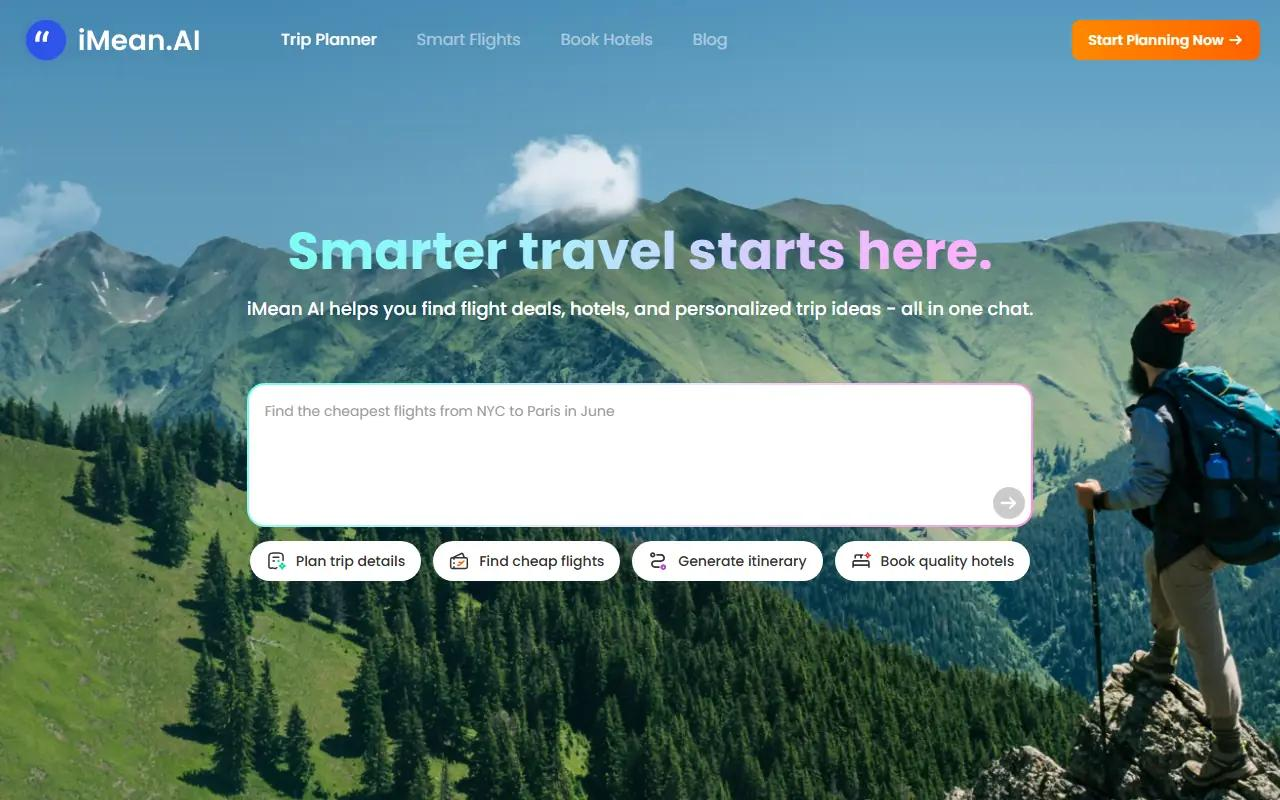
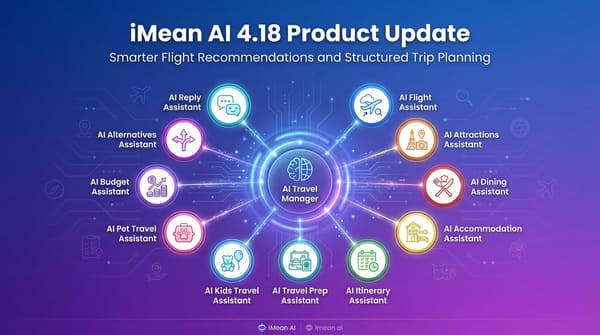
iMean AI is a conversational trip planner designed to turn incomplete travel ideas into a structured plan. Users can begin with a destination, budget, travel period, or even a general description of the experience they want.
For example, a traveler could request a ten-day budget-conscious trip through Italy, a family vacation across several cities, or a warm-weather destination with affordable flights. The plan can then be refined as preferences change.
The platform connects several important parts of travel planning:
- Personalized day-by-day itineraries
- Flight discovery and fare options
- Hotel recommendations
- Destination and activity ideas
- Multi-city planning
- Budget-aware suggestions
- Conversational itinerary adjustments
The connection between itinerary generation and practical travel research is important. Many AI tools are capable of suggesting attractions but still require travelers to open several separate services when they begin comparing flights, hotels, and routes.
iMean is most useful when the traveler has clear preferences but has not assembled a complete plan. Instead of requiring every detail at the beginning, it can progressively refine the trip through follow-up conversations.
Travelers who have not yet chosen a destination can also browse iMean Discover for travel inspiration before turning an idea into a more complete itinerary.
For an independent product overview, travelers can view iMean AI on Toolify. The listing covers its itinerary, flight, hotel, attraction, and activity-planning capabilities.iMean is also listed on Futurepedia, providing another third-party reference for travelers comparing AI products.
iMean has also appeared in a head-to-head comparison published by competing AI travel planner Layla. Although the article naturally favors Layla’s own end-to-end booking model, it identifies iMean’s real-time price scanning across booking sites as its clearest strength, particularly for travelers looking for competitive flight and hotel combinations. Readers can view Layla’s comparison of iMean and other AI trip planners for another perspective.
Who is iMean best for?
iMean is particularly suitable for:
- Travelers organizing multi-city trips
- People comparing flights and hotels while planning
- Families with specific budgets and preferences
- Solo travelers who need a structured starting point
- Users who prefer conversation over complicated forms
- Travelers who expect to revise their plans several times
Like every AI planner, its recommendations should be verified before booking. Flight schedules, hotel availability, attraction opening hours, and entry requirements can change.
Travelers who mainly want a highly visual map or a shared group-planning workspace may prefer Mindtrip or Wanderlog. For users trying to connect inspiration, itinerary generation, flights, and hotels in one workflow, iMean offers a broader starting point.
2. Mindtrip
Best for visual travelers who want maps, destination content, and itinerary organization in one place.
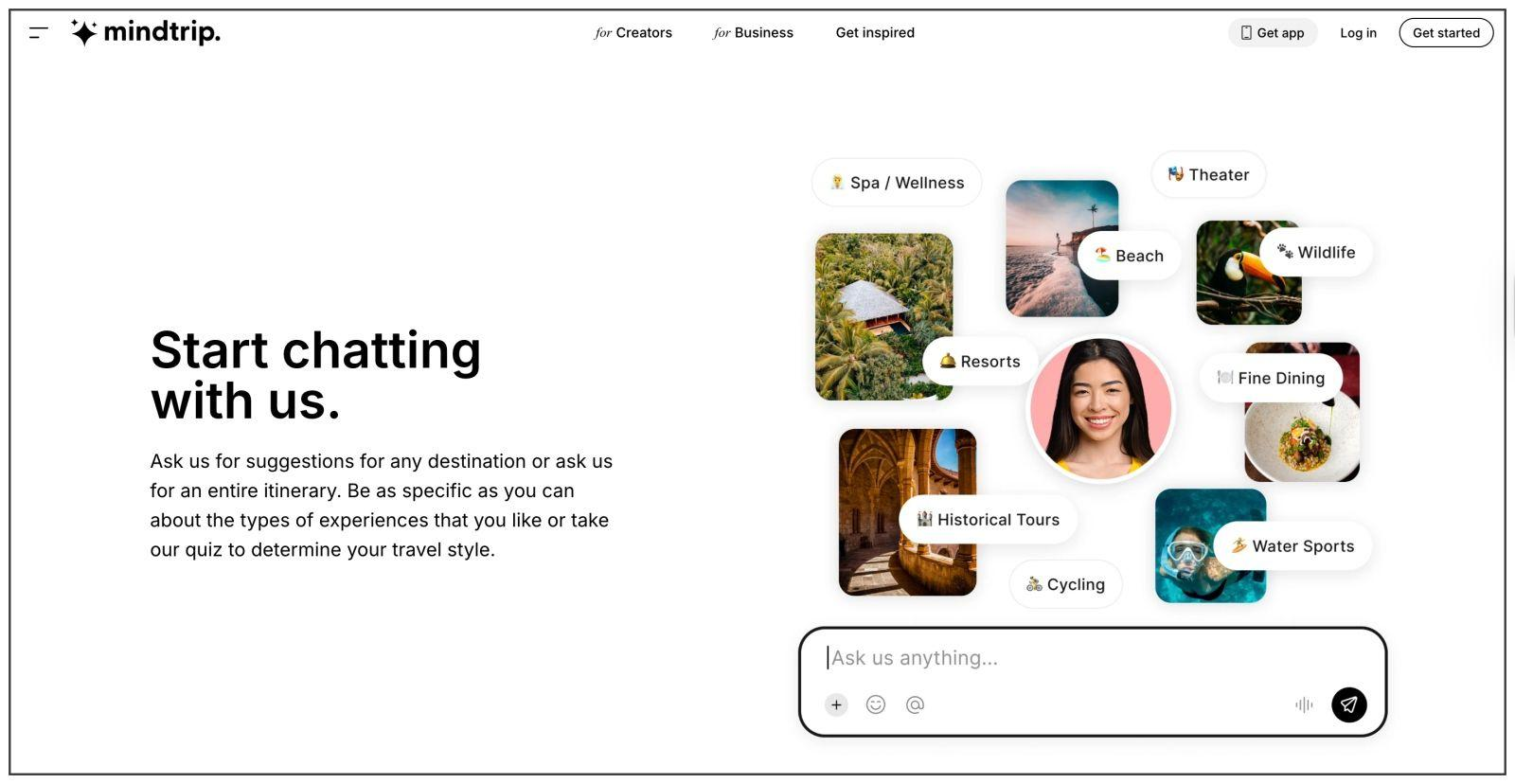
Mindtrip combines a conversational planning assistant with maps, photos, destination information, and customizable trip plans.
Users can request an itinerary, explore recommended hotels and attractions, and add selected places to a visual plan. This format is useful for travelers who want to understand where different stops are located before deciding how to organize each day.
Mindtrip continued expanding its destination partnerships in 2026, including projects involving Meet Boston, Visit Orlando, and Arkansas Tourism. These partnerships indicate that the company is positioning its technology for both individual travelers and destination organizations.
That institutional expansion does not necessarily change the everyday consumer experience. For most travelers, Mindtrip remains a visual planning tool centered on destination discovery, maps, recommendations, and itinerary customization.
Mindtrip is particularly useful for:
- Visual destination research
- City breaks and leisure trips
- Travelers who want maps integrated into planning
- Couples or families comparing possible activities
- Users who collect inspiration before finalizing an itinerary
The main limitation is that an attractive visual plan can still contain practical problems. Transportation time, reservation requirements, opening hours, and seasonal closures need to be checked.
For someone who only wants a quick itinerary without extensive destination browsing, Mindtrip may offer more visual information than necessary.
3. Layla AI
Best for travelers who want to build a vacation through a conversational interface.
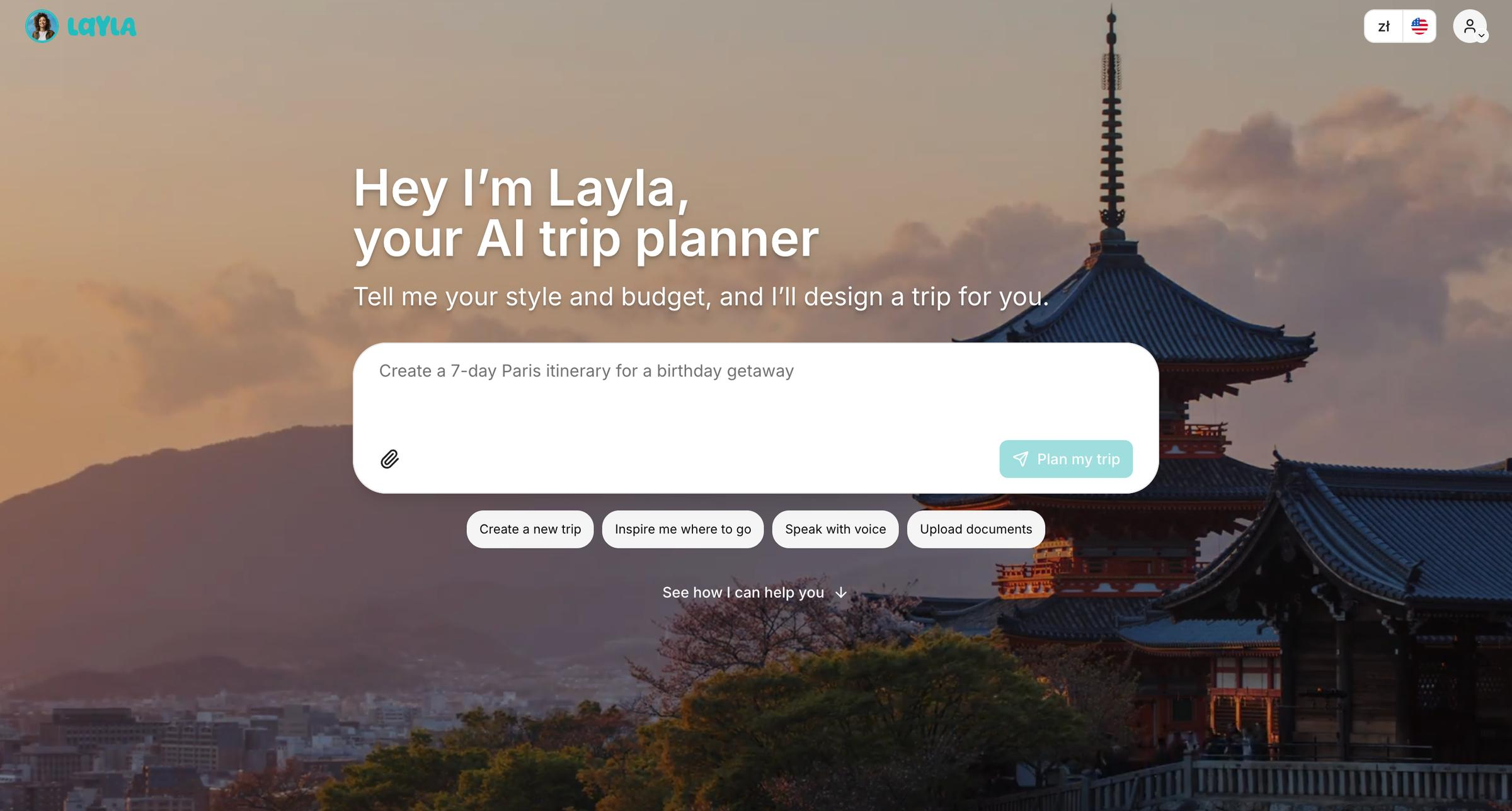
Layla AI allows users to describe a destination, budget, preferred pace, interests, and travel companions through a natural conversation. It can then turn those preferences into destination suggestions or a structured itinerary.
Layla became one of the most closely watched travel-planning products in 2026 after being acquired by Expedia Group. The acquisition places the conversational assistant inside a much larger travel ecosystem covering accommodation, flights, and activities.
The deal is notable as an industry event, but it does not automatically mean that every part of the Layla experience has already changed. It remains too early to determine how extensively Expedia’s inventory, booking infrastructure, and account systems will be incorporated into the standalone product.
For users, Layla’s immediate proposition remains conversational planning. Follow-up requests can make a plan slower, cheaper, more family-friendly, or more focused on food, beaches, or particular activities.
Layla is suitable for:
- Vacation inspiration
- Conversational itinerary generation
- Travelers who want quick recommendations
- Users comparing possible destinations
- People who prefer an informal planning experience
The conversational format is accessible, but travelers with complicated multi-city routes, strict transportation requirements, or detailed scheduling constraints may still need to organize parts of the trip manually.
Layla had previously acquired the itinerary-building tool Roam Around in 2024 before being acquired itself by Expedia in 2026, reflecting the continuing consolidation of AI travel-planning products.
4. Wanderlog
Best for collaborative travel planning, road trips, and detailed itinerary organization.
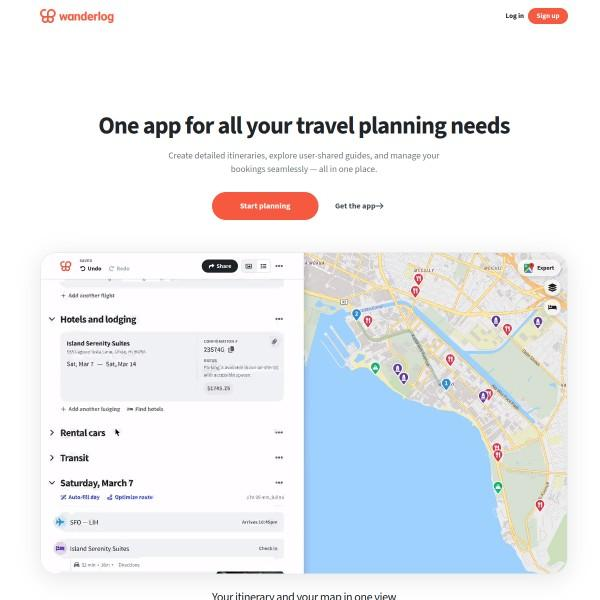
Wanderlog combines itinerary organization, maps, reservations, budgeting, route planning, and collaboration.
It is particularly useful for friends, families, or couples planning together. Multiple travelers can add ideas, organize daily activities, save reservations, and maintain a shared view of the trip.
The platform also works well for road trips. Seeing destinations and stops on a map makes it easier to understand distances and avoid building a schedule with excessive driving.
In 2026, Wanderlog continued expanding beyond pre-trip planning with features such as Trip Journal. The feature allows travelers to map completed trips, add photos, record stops, and share the journey afterward.
This broadens Wanderlog’s role, although its central strength remains organization rather than AI-first conversation.
Wanderlog is a good option for:
- Group travel
- Road trips
- Shared itinerary editing
- Map-based planning
- Budget tracking
- Organizing flights and hotel reservations
- Travelers who prefer manual control
Compared with a chat-first AI planner, Wanderlog can require more hands-on organization. That is useful for travelers who want detailed control but may feel slower for someone seeking an instantly generated plan.
Its range of features can also be excessive for a simple weekend trip. For longer or collaborative journeys, the additional structure becomes more valuable.
5. Wonderplan
Best for travelers who want a simple itinerary without a complicated setup process.
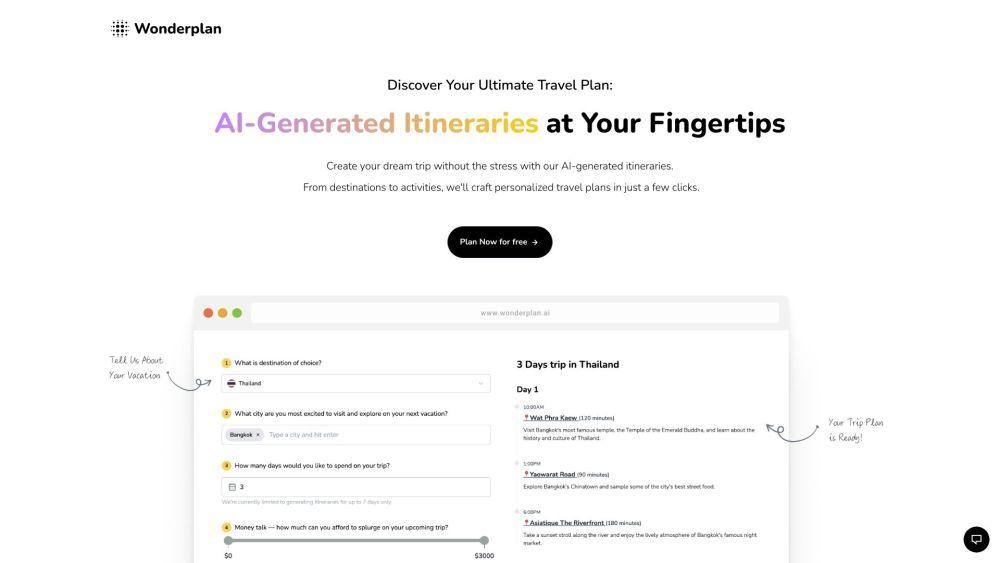
Wonderplan focuses on turning basic trip information into an editable daily plan. Users provide details such as destination, duration, budget, interests, and travel companions, and the tool generates a proposed itinerary.
While several competitors moved toward booking integrations and larger travel ecosystems in 2026, Wonderplan remained relatively focused on lightweight itinerary generation.
Its current features include editable daily plans, hotel discovery, the ability to reorder or remove locations, and downloadable PDF itineraries for offline access.
Wonderplan works well for:
- First-draft itineraries
- Short city trips
- Budget-conscious travelers
- Users who already know their destination
- People who want results without a long conversation
Its simplicity is also its main limitation. Travelers who need integrated flight research, detailed hotel comparison, extensive collaboration, or complicated multi-city logistics will probably need additional services.
The generated plan should be treated as a starting point. Opening hours, ticket requirements, travel times, and seasonal conditions must still be verified.
6. Trip Planner AI
Best for organizing known destinations and attractions into a structured daily schedule.
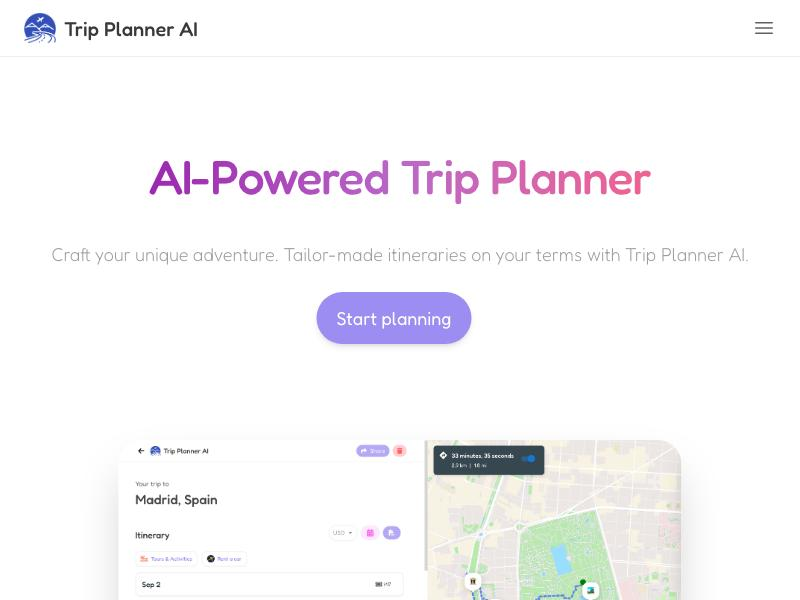
Trip Planner AI creates travel plans from destinations, dates, interests, and other preferences. Its itineraries are generally organized by day, helping users understand how selected activities could fit into the available time.
Unlike Layla and Mindtrip, Trip Planner AI did not generate the same level of acquisition or partnership news in 2026. Its proposition remains narrower and relatively straightforward: turn destination choices into an organized itinerary.
That can be useful for travelers who already know where they are going but have not decided how to arrange each day.
Trip Planner AI is suitable for:
- Day-by-day scheduling
- Multi-stop itineraries
- Attraction planning
- Users who want an organized route
- Travelers who prefer structure over open-ended inspiration
The quality of the output depends on the detail of the request. Generic preferences can lead to generic plans, while specific information about pace, budget, interests, and transportation usually produces a more relevant result.
It may be less useful during the early inspiration stage when the traveler has not selected a destination. Users should also check whether the suggested schedule allows realistic transportation and rest time.
7. GuideGeek
Best for travelers who want AI assistance through familiar messaging platforms.
Suggested image: GuideGeek travel conversation inside WhatsApp or Instagram.
Alt text: GuideGeek AI travel assistant providing recommendations in a messaging app.
GuideGeek provides conversational travel assistance through platforms such as WhatsApp, Instagram, and Facebook Messenger. Users can ask questions about hotels, restaurants, attractions, destinations, and possible itineraries without learning another dedicated application.
In 2026, GuideGeek moved closer to the transaction stage through a partnership with Ripe. The integration is intended to support real-time booking within destination-focused travel conversations.
The development is relevant because GuideGeek originally stood out mainly for making travel assistance accessible through messaging apps. The practical impact of its booking integrations will depend on destination coverage and the inventory available in each market.
GuideGeek works well for:
- Quick destination questions
- Mobile travel research
- Restaurant and attraction recommendations
- Travelers who already use messaging apps
- Advice while a trip is in progress
Its conversational accessibility does not necessarily replace a complete itinerary workspace. Users who want maps, reservation organization, collaboration, or a detailed visual schedule may need to move the recommendations into another platform.
GuideGeek is therefore better understood as an accessible travel assistant than as a full project-management system for complex trips.
8. ChatGPT with GPT-6 Astra
Best for complicated travel research and highly customized planning requirements.
Suggested image: OpenAI’s official GPT-6 Astra visual or a ChatGPT conversation using Astra for travel planning.
Alt text: ChatGPT with GPT-6 Astra analyzing a complex travel itinerary.
GPT-6 Astra gave ChatGPT renewed attention in 2026. OpenAI positions Astra as its flagship model for complex end-to-end work, with support for long-context reasoning, images, web research, and tool use.
For travel planning, these capabilities can help when the user needs to process a large amount of information. Travelers can provide hotel options, flight screenshots, visa documents, destination guides, budgets, and personal requirements in one conversation.
ChatGPT can then help compare the options, identify conflicts, organize research, and generate different versions of an itinerary.
Its flexibility is useful for:
- Multi-country travel research
- Trips involving many personal constraints
- Destination comparisons
- Analyzing screenshots and documents
- Creating packing and preparation lists
- Reworking an itinerary after requirements change
- Brainstorming unusual or highly specific trips
However, Astra does not turn ChatGPT into a dedicated travel platform.
ChatGPT can perform sophisticated reasoning, but users may still need separate services for live flight inventory, hotel booking, maps, reservation management, and structured itinerary editing. Its strength is flexibility rather than a complete travel-specific product experience.
For travelers comfortable organizing the final results themselves, ChatGPT with GPT-6 Astra can be a capable research tool. Users looking for an integrated planning interface may find a dedicated platform more convenient.
How to Choose the Best AI Trip Planner
The best choice depends on which part of the planning process creates the most work.
Choose iMean for an all-in-one starting point
iMean is relevant when you want to connect destination discovery, itinerary creation, flights, and hotels. It reduces the need to begin the planning process across several unrelated websites.
Choose Mindtrip for visual discovery
Mindtrip is useful when maps, destination photos, and visually organized recommendations are central to how you make travel decisions.
Choose Layla for conversational vacation planning
Layla works well for travelers who want the planning process to feel informal and interactive. Its acquisition by Expedia makes its future integration with a larger travel ecosystem worth watching.
Choose Wanderlog for groups and road trips
Wanderlog is better suited to shared editing, driving routes, reservation organization, and travelers who want detailed control.
Choose Wonderplan for speed and simplicity
Wonderplan is appropriate when you already know the basic trip details and want a quick, editable itinerary.
Choose Trip Planner AI for daily structure
Trip Planner AI is useful when the primary challenge is arranging attractions and activities into a schedule.
Choose GuideGeek for messaging convenience
GuideGeek makes sense when you want quick travel recommendations without downloading or learning another planning application.
Choose ChatGPT with GPT-6 Astra for complex research
ChatGPT is useful when the trip involves extensive documents, comparisons, screenshots, or unusual personal constraints. It is less suitable as a complete booking and itinerary-management platform.
What Should a Good AI Trip Planner Include?
A useful AI trip planner should do more than produce a generic list of attractions.
Personalized recommendations
The planner should account for budget, interests, group size, preferred pace, transportation, and other meaningful constraints.
Editable itineraries
Users should be able to remove an activity, change a hotel, slow down a schedule, or add another destination without rebuilding everything.
Realistic daily planning
An itinerary should consider distance, transportation time, opening hours, rest periods, and how many activities can realistically fit into one day.
Flight and hotel support
Tools that connect itinerary creation with flights and accommodation reduce the number of separate searches required.
Maps and route visibility
Maps make it easier to identify inefficient routes and understand where hotels, attractions, and transport hubs are located.
Collaboration
For group trips, shared editing may be more useful than advanced AI generation.
Current information
Prices, schedules, availability, entry rules, and opening hours change frequently. AI recommendations become more useful when connected to current travel data.
Are AI Trip Planners Reliable?
AI trip planners can save time, but they should not be treated as unquestionable authorities.
A generated itinerary may contain:
- Outdated opening hours
- Unrealistic travel times
- Activities that require advance reservations
- Hotels that are unavailable for the selected dates
- Incorrect seasonal assumptions
- Missing visa or entry requirements
- Recommendations that do not reflect accessibility needs
Before booking, verify important details through official sources, airlines, hotels, attractions, and government websites.
The most reliable approach is to let AI handle organization and early research while keeping final decisions under human control.
Frequently Asked Questions
What is the best AI trip planner in 2026?
There is no universal winner. iMean is a broad option for itineraries, destination discovery, flights, and hotels. Mindtrip emphasizes visual planning, while Wanderlog is particularly useful for collaboration and road trips.
What is the best free AI trip planner?
Several products offer free access or free planning features, including iMean, Mindtrip, Layla, Wonderplan, and GuideGeek. Usage limits and premium features may change, so travelers should check current terms.
Is GPT-6 Astra good for travel planning?
GPT-6 Astra is useful for complex research, multi-country itineraries, document analysis, and plans involving detailed constraints. It remains a general-purpose model rather than a dedicated travel-booking platform.
Why did Expedia acquire Layla?
Expedia described the acquisition as part of its strategy to expand AI-powered travel planning across inspiration, planning, booking, and traveler support. The long-term effect on Layla’s standalone product remains to be seen.
Can AI plan a multi-city itinerary?
Yes. Tools such as iMean, Mindtrip, Wanderlog, and Trip Planner AI can help organize multi-city trips. Travelers should still verify transportation time and whether the schedule is realistic.
Can AI replace a travel agent?
AI can replace part of the research and organization process for straightforward trips. Human agents remain valuable for complex bookings, specialist destinations, emergencies, luxury arrangements, and situations requiring professional accountability.
Final Verdict
The AI trip-planning market became more commercially significant in 2026.
Expedia’s acquisition of Layla showed that major travel companies are interested in conversational planning. Mindtrip’s destination partnerships demonstrated another route through tourism organizations. GuideGeek moved closer to bookings, while GPT-6 Astra expanded what general-purpose AI can do with complex travel research.
These developments do not make one product automatically better than another.
Mindtrip remains strongest as a visual planning environment. Layla emphasizes conversational vacation creation. Wanderlog is useful for collaboration and road trips. Wonderplan and Trip Planner AI focus on straightforward itinerary generation. GuideGeek offers convenient messaging access, while ChatGPT provides broad research flexibility.
For travelers who want to connect destination inspiration, flights, hotels, and personalized itineraries in a single travel-focused experience, iMean AI is one of the most complete options to explore in 2026.
Its Discover section provides an entry point for destination inspiration, while its Toolify and Futurepedia listings give travelers independent pages where they can review the product before deciding whether to use it.
Whatever tool you choose, treat the generated itinerary as a flexible foundation. Verify important details, adjust the plan around real-world conditions, and make sure the finished trip reflects how you actually want to travel.