
What Is an AI Trip Planner?
An AI trip planner is a tool that uses artificial intelligence to help you plan your trip, based on the information you provide. Modern AI trip planners don’t just rely on a single model; instead, most of them work as a coordinated system with several layers working together. And the technology can be broken down into four major components.
1.How AI Reads Your Travel Needs
AI Trip Planners typically understand users' needs through the information they input, such as text, images, or URLs. Then, through natural language processing (NLP), users' information would be structured into specific requirements as follows.
- Departure and destinations
- Trip duration
- Budget
- Travel pace
- Special constraints
The purpose is simple: turn vague human language into clear parameters that AI can handle. For an AI trip planner, understanding user needs is the first step for itinerary planning.
2.Where the Data Comes From
Without accurate data and rich content, even the smartest AI can not draw up an effective itinerary. Their core functions are based on external data sources, including:
- Real-time information on flights, hotels, or even trains
- POI database and creator contents
- Database of restaurants, attractions, or activities
- Local insights, such as queue time or crowd levels
This information is not natively available in Large Language Models (LLM) but is retrieved via retrieval-augmented generation (RAG), search systems, or official application programming interfaces (APIs). These data are just like the "external knowledge base" of AI trip planners, which ensures the accuracy and availability of the itineraries.
3.How Multi-model Systems Build Itineraries
The Multi-model coordination is a key factor for the best AI trip planners. It combines user needs and external data into real and executable itineraries.
- LLM is responsible for understanding user needs and then uses its language skills and common sense to generate a readable, reasonable, and executable itinerary.
- The recommendation model recommends activities according to user preference and optimizes the sequence to minimize detours or balance the pace. Thus, you can get personalized itineraries.
- The auto-adjustment model enables users to adjust the itinerary without extra effort. For example, you can add more shopping activities by telling AI trip planners, "I want more shopping time."
4.How AI Trip Planners Connect Planning With Real Execution
The best AI trip planner is not just an itinerary generator, but also integrated hubs for execution and collaborative travel planning to enhance and simplify users' travel planning experience.
- Book flights, hotels, or activities directly
- Visual itinerary for daily use during the trip
- Real-time collaboration for planning
- Budget tracking to avoid overspending

Benefits of Using an AI Trip Planner
Now, we know how AI Trip Planners work. Let's move to a more practical question: Why are AI trip planners taking over traditional travel planning methods?
Faster than traditional planning
- For planning a trip, you need to jump across flight websites, hotel platforms, maps, blogs, and TikTok travel creators. Comparing hotel prices, clarifying your needs, and sorting out the route all of these take days, or even weeks. The information you need is scattered everywhere, and you need to integrate it all by yourself.
- But AI trip planners consolidate everything. They draft itineraries within seconds and adjust the plan according to your feedback.
Better price comparison
- Opening six tabs at the same time is already overwhelming for a planner.
- Just one AI Trip planner website can handle dozens of data points instantly. They can calculate more reasonable choices of flights, hotels, and routes based on your preferences and budget.
More Personalization Than Standard Itineraries
- The same "top 10 must-visit attractions" lead to the same route. Whether you are a backpacker, a couple, or traveling with family, there is a ready-made strategy that fits your budget, path, or preferences.
- AI trip planners usually generate itineraries based on the information users input: whether you prefer a relaxed or an active pace, more natural attractions or city activities, how much the budget is, and whether you’re traveling with children or elderly companions.
Comparing the Best Three AI Trip Planners: Layla, iMean AI, and Mindtrip
Layla: Best for inspiration-driven trips
Layla is more likely to be a content-driven travel agent. It generates stylish itineraries based on chatting with users. Layla is great for inspiration exploration, but struggles with flight price comparisons and complex route planning.
Pros:
- Friendly chat-based planning enables you to refine your itinerary step by step
- Download the itinerary PDF and share it with your companions
- Offer flight and hotel booking links
Cons:
- Only one free planning chance
- Struggles with multi-city or complex routes
- Generate non-existent transport connections sometimes
- Not very flexible when adjusting routes
iMean AI: Best for complex, multi-city, budget-limited planning
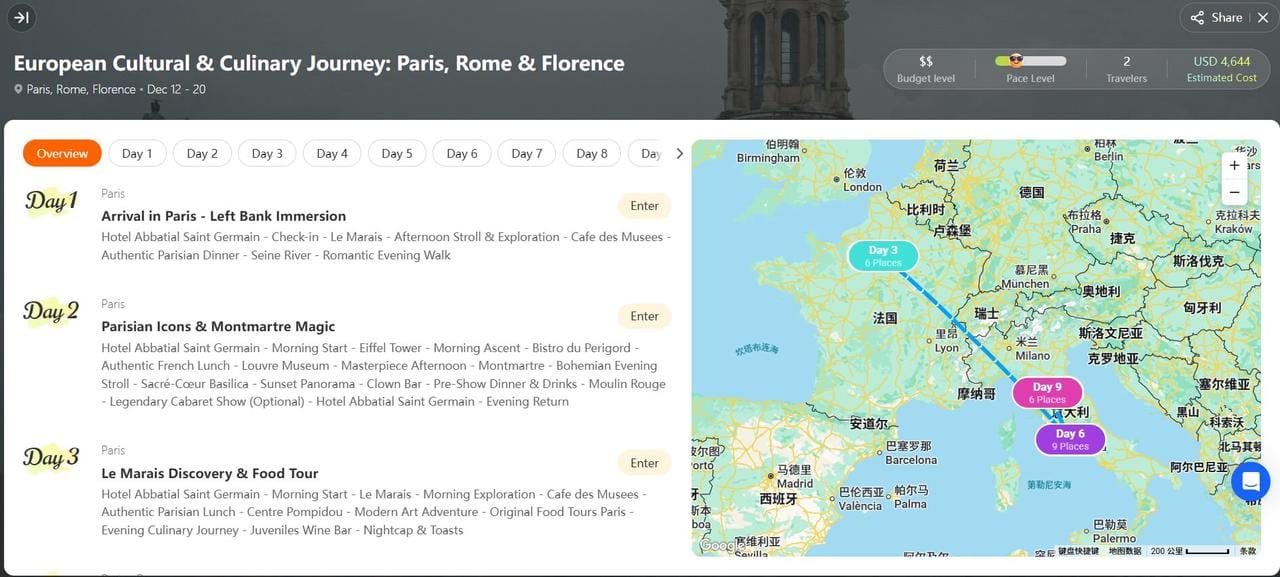
iMean AI is designed not only for planning but also for execution. With the ability to handle multi-city trips, complex needs, and instant adjustment, it can generate the smoothest itineraries. What's more, you can compare the prices of flights and hotels and order them on the same website. It's the best tool to control your budget.
Pros:
- Good at multi-city planning for group trips
- Real-time flight and hotel data for comparison and decision-making
- Full-market flight comparison, not limited to Online Travel Agency (OTA)
- Free to use, complete your plan without any additional charges
- Optimize the itinerary automatically, like minimizing detours and controlling the budget

Cons:
- Need more time to generate a more accurate and available itinerary
- Occasionally, the details are not clearly expressed
- Currently, the web version only, but the mobile app is coming soon
Mindtrip: Best for brainstorming & collaborative idea sharing
Mindtrip features inspiration discovery and collaborative planning. You can start planning not only with text but also with pictures or URLs. The function of collaborative planning is convenient for brainstorming with your co-planner. But for complex itineraries, it's not powerful enough. So as the ability to provide available flights and trains.
Pros:
- Great for brainstorming and ongoing conversation
- Easy link sharing with friends
- Can start planning with a photo or URL
- Strong map-based browsing and idea discovery
Cons:
- No directly bookable train options, and limited flight choices available
- No real-time budget display, not friendly for budget-conscious travelers
- Without permission controls, the links shared have no protection

Which AI Trip Planner Should You Use?
Choosing the right AI trip planner depends on what kind of traveler you are and how complex your trip is. Each tool offers a different strength, so the best choice comes from matching your needs with the right product.
If you want inspiration-driven planning
Choose Layla. It is great for exploring ideas, building mood boards, and chatting your way to a stylish draft itinerary. Ideal for travelers who enjoy browsing and refining creatively.
If you need accurate multi-city or budget-limited planning
Choose iMean AI. It handles complex itineraries, compares real flight and hotel prices, and adjusts routes instantly. Perfect for families, groups, or travelers with detailed constraints.
If you want collaborative brainstorming
Choose Mindtrip. Its strength is visual discovery, map-based browsing, and co-planning with friends. Best for early-stage idea sharing or casual exploration.
If you want an all-in-one planning and execution tool
Choose iMean AI. It offers itinerary building plus booking integration and budget control, making it a more complete solution for end-to-end planning. In short, inspiration seekers can choose Layla, collaborative planners can choose Mindtrip, and travelers who need precision, budget clarity, and multi-city planning should choose iMean AI.
Final thought
AI trip planners are practical, time-saving, and highly personalized travel companions. Whether you’re looking for inspiration, complex multi-city planning, or collaborative trip brainstorming, the best AI trip planner can simplify the entire process. From real-time flight and hotel data to automatically optimized itineraries, you can choose an AI tool that fits your needs to make planning faster, smarter, and more enjoyable. Give it a try and co-plan your next trip with an AI trip planner.
Recommended further reading:
 Chloe
Chloe
 Chloe
Chloe
 Aiden
Aiden