Bleisure travel, as the name implies, is a trip for both work and leisure. People add leisure activities before or after a business trip, or in between two different work locations. It’s also a way for companies to increase employees’ job satisfaction. But planning a bleisure trip is not easy, because the boundaries between work and leisure can easily get blurred. Poor planning can affect work and make the trip more tiring. This blog gives you bleisure travel tips on how to plan a bleisure trip and how AI can help.
Why Bleisure Trips Feel Harder Than They Look
Work and travel operate in very different modes. That difference doesn't make bleisure travel impossible, but it does make it harder than it seems. It only works when time and boundaries are clearly planned in advance. Otherwise, you end up with a trip that you cannot fully rest, and cannot fully focus on work either.
Common Challenges
Cognitive Load & Context-SwitchingSwitching back and forth between work and sightseeing can lead to scattered attention and make it hard to focus on either. Think about it, you try to enjoy your trip, but there is a meeting the next day, and you are not prepared yet. It's really hard to relax and have fun.Work Environment IssuesFinding the right place to work productively can be hard. You need reliable Wi-Fi, a pleasant environment, at least a comfortable chair, and a quiet environment. It becomes even harder if you have to work while traveling.Blurring BoundariesBad bleisure trip planning can blur the boundaries between work time and personal time. When work is always there, it's hard to truly relax. Your leisure time can be interrupted by unexpected emails or calls. At the same time, your work can become less efficient, especially when work and travel time are not well planned and get mixed together.Physical & Mental StrainWork itself is tiring. A packed travel itinerary can be exhausting, too. When the two are combined, it can lead to burnout, less personal time, and stress. All of these affect both your physical and mental health.Productivity GuiltMany employees feel guilty about extending a business trip for leisure, so they take on more work to prove their value. This also leads to feeling exhausted and stressed.
Key Mistakes of Bleisure Planning to Avoid
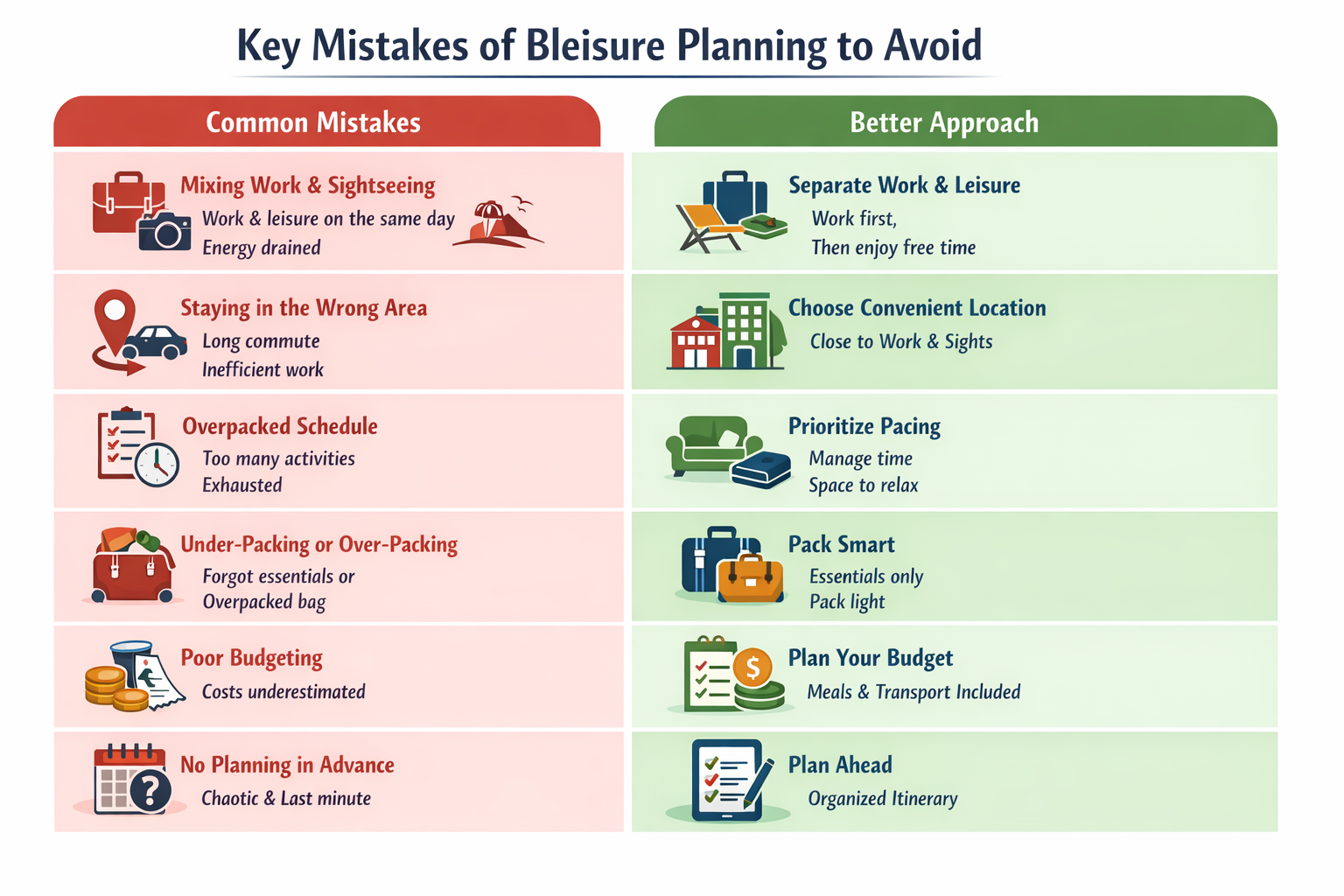
A successful bleisure travel planning isn't just about making your trip longer. Many travelers make mistakes and turn a relaxing bleisure trip into a stressful and exhausting experience.Here are the most common bleisure planning mistakes:
- Mixing work and sightseeing on the same day. Blurred boundaries make it hard to find balance and drain your energy.
- Staying in the wrong area. A wrong location makes work less efficient and sightseeing harder. Commuting is troublesome and also affects your rest.
- Overpacked schedule. Too many activities that make you tired and need more time to recover, especially since you still have work after the trip.
- Under-packing or over-packing. You need to pack for both work and sightseeing. Bringing too much or forgetting essentials adds stress to your trip.
- Poor Budgeting. Many travelers underestimate the cost of meals, transport, and activities that are outside their company's policy. It makes budgeting much harder.
- No planning in advance. You might waste time or have a busy trip without really enjoying it.
Avoiding these mistakes is key to having a work-life balance trip. In the next part, we will explore principles of a good bleisure itinerary.
Principles of a Good Bleisure Itinerary
If you want to enjoy your trip while getting your work done well, you need a plan that balances your schedule, energy, and priorities. Here are some principles of how to plan a bleisure trip.
Separate Work and Leisure Blocks
When planning your trip, put important work tasks as a top priority. Make sure that all of your work can be completed on time. Try to separate work days and leisure days. Mixing them can make your schedule more stressful. If work and travel activities are on the same day, try to block your work into one focused period, then use the rest of the day to explore.
Prioritize Pacing over Sightseeing
A good bleisure trip should focus more on your travel pace and energy, not on how many places you visit. Travelers need to learn to make trade-offs. Leave some space between activities and control the number of highlights each day. This can help you stay energized and avoid getting too tired, especially when you still have work to do. A slower pace can make your trip more enjoyable.
Include Commute and Recovery Time
Do not ignore commute and recovery time. Travelling between locations and time to rest is part of the itinerary, not extra. Ignoring these can make your day rushed and exhausting. Leave time for relaxed commuting and rest to make your itinerary more practical. What's more, the location of your accommodation also matters. Staying in a convenient location can save you a lot of commute time and leave your energy for what really matters.
How AI Helps You Separate Work Time and Travel Time
What the AI trip planner can help you with is not pack your schedule but make your plan clear. That way, both work and travel feel easier and more balanced.Divide Your Trip by Work and LeisureAI splits your bleisure trip into work days and leisure days based on your fixed work commitments, like meetings, and the free time you have. If a day has both work and sufficient free time, the AI can arrange the schedule smartly. For example, it may suggest finishing work in the morning or choosing convenient locations during your trip to get work done easily.Plan Energy Around Your ScheduleAI can help you plan your energy based on how your time is divided. For example, if you have free time before a workday, the AI can plan some light activities after your work prep is done. Thus, you can enjoy yourself while saving energy for the next day. Likewise, it's better to plan some relaxing activities before the trip comes to an end. This way, you can reset and be ready for work when you get back.Choose the Best Place to StayFor a bleisure trip, where you stay matters more than how well the hotel is. The AI can analyze the best area for you to stay based on your itinerary. Then it finds the hotel that meets your personal needs, like reliable Wi-Fi and good value for money. It can also adjust your stay as your schedule changes.Create a Clear, Structured PlanAI can help you with the hardest part: making a structured plan. Most people know what they want, but don't know how to turn their needs into a real and workable itinerary. That's what an AI travel planner can help you with.Handle Last-Minute ChangesAI can also help you deal with unexpected changes. When you are on a bleisure trip, situations like meeting reschedules and flight delays can happen, which leave you with extra days of free time. What should you do with this unexpected free time? AI can help you generate the itinerary in a few minutes. It can find flights, recommend hotels, and suggest places to visit, all in one place.
A Simple Example: Planning a Bleisure Trip with AI
I am planning a bleisure trip. I will depart from London for Milan on February 15 and stay for 3 days, and February 16 is my work day. On February 17, I will travel from Milan to Düsseldorf and stay for 2 days with no work. Then, on February 19, I will go from Düsseldorf to Paris, with 2 days of work followed by 2 days of leisure. After that, I will return from Paris to London. Direct flights in business class for all legs of the trip, if possible. This is the itinerary for the multi-destination bleisure trip.The AI divided the trip into work days and leisure days. The boundaries are clear, and the itinerary is easy to follow. Direct business-class flights that are no longer than 1 hour and 50 minutes save the traveler's energy and time, which allows travelers handle both work and sightseeing more comfortably.
Final Thoughts
A successful bleisure trip is not about trying to do everything at once. It is about keeping clear boundaries between work and leisure so you can enjoy both without stress. Use an AI trip planner to design bleisure trips that respect your work and your time off.