
Planning a trip to London can be difficult because there is so much to see and do. A visitor can easily feel lost among the attractions that are spread across the city. Thus, you need a London trip planner. But most of the traditional trip planner websites can only provide recommendations or must-do lists for some fixed types of travelers. They can't generate personalized itineraries or even connect planning with real execution. That's what an AI trip planner can help you with.
In this article, you will get a step-by-step roadmap to plan your London trip with our free trip planner.
Best Time to Visit London
London's weather is generally mild, with pleasant summers and mild winters. The best time to visit London depends on your time, preference, and budget. Some periods can be more crowded because of holidays and cultural activities, while other periods are much quieter, with lower hotel prices and cheaper flights.
Best Time for Enjoying Nature
Spring, from March through May, is the best time for nature lovers, as the weather is mild and the city's parks are green and blooming.
Summer, one of the peak seasons around the year, is best for people who are likely to see sunny and warm days.
And finally, autumn is another charming season, warm but not as crowded as summer. The ivy often turns first in mid-October, with tree leaves following around the end of the month.
Best Time for Feeling London Alive
From late spring to summer is London's peak tourist season, and also the time of year with the longest daylight hours. Key Events like Trooping the Colour, Wimbledon Championships, and Notting Hill Carnival fill up diaries. And also the Christmas period, from late November, the lights begin to twinkle, and the air fills with the scent of mulled wine. Christmas markets bring a magical atmosphere to London.
Best Time for Budget-limited Travelers
January and February in London are more budget-friendly for tourists. Especially in January, when many Christmas decorations and shows are still on display. It is the best time for visitors to shop, visit museums, and avoid crowds. But winter in London is cool, damp, and often grey, and it often rains, so remember to pack warm clothes and bring an umbrella.
How Many Days for a Trip to London
For first-time visitors, 4 full days are needed. You can not only have the experience of essential must-see landmarks, but also give yourself some breathing time. If you want to learn more about the history and culture of the city, consider staying a week or even longer.

How to Plan Your Trip with an AI Trip Planner
What's the purpose of your trip? Who are you traveling with? What are your preferences? And how much is your budget? Don't worry, use the best trip planner to get a personalized itinerary.
Input your needs, and iMean AI will work as your most reliable co-planner, which can compare flights and hotels across the web to save both your money and energy. What's more, no matter what unexpected situation occurs, it can help you adjust the plan instantly. Here is the step-by-step roadmap for you.
Step 1: Input your requirements
Here is a simple prompt for your trip planning. You can also use your own words.
Prompt: I’m about to plan a week-long trip to London with a budget of around $4000 for 3 people: me (22 Female), my mom (60 Female), and my dad (59 Male). Departing from New York in May. The travel pace should be moderate. My mom is artsy and is interested in plays, museums, gardens, and shopping. My dad is really into military history and likes to see churches and historical sites. And there are some sites we'd like to see: Big Ben, the British Museum, and IWM London.
Step 2: Adjust the itinerary
After the itinerary is generated, check and adjust the plan to make sure the final plan is exactly what you want. Whether you want to add or remove activities or adjust your budget, tell it your need.
Step 3: Select your flights and hotels, and book them directly
Compared to traditional trip planner websites, you don't need to compare the price of flights and hotels yourself, jumping between different tabs endlessly. The AI trip planner automatically scans the best options across the web and presents you with clear choices.
Step 4: Share your itinerary with your fellow travelers
Click the "share" button, and your fellow travelers who are not with you can also know the itinerary instantly. Moreover, they can check the travel plan anytime during the trip.
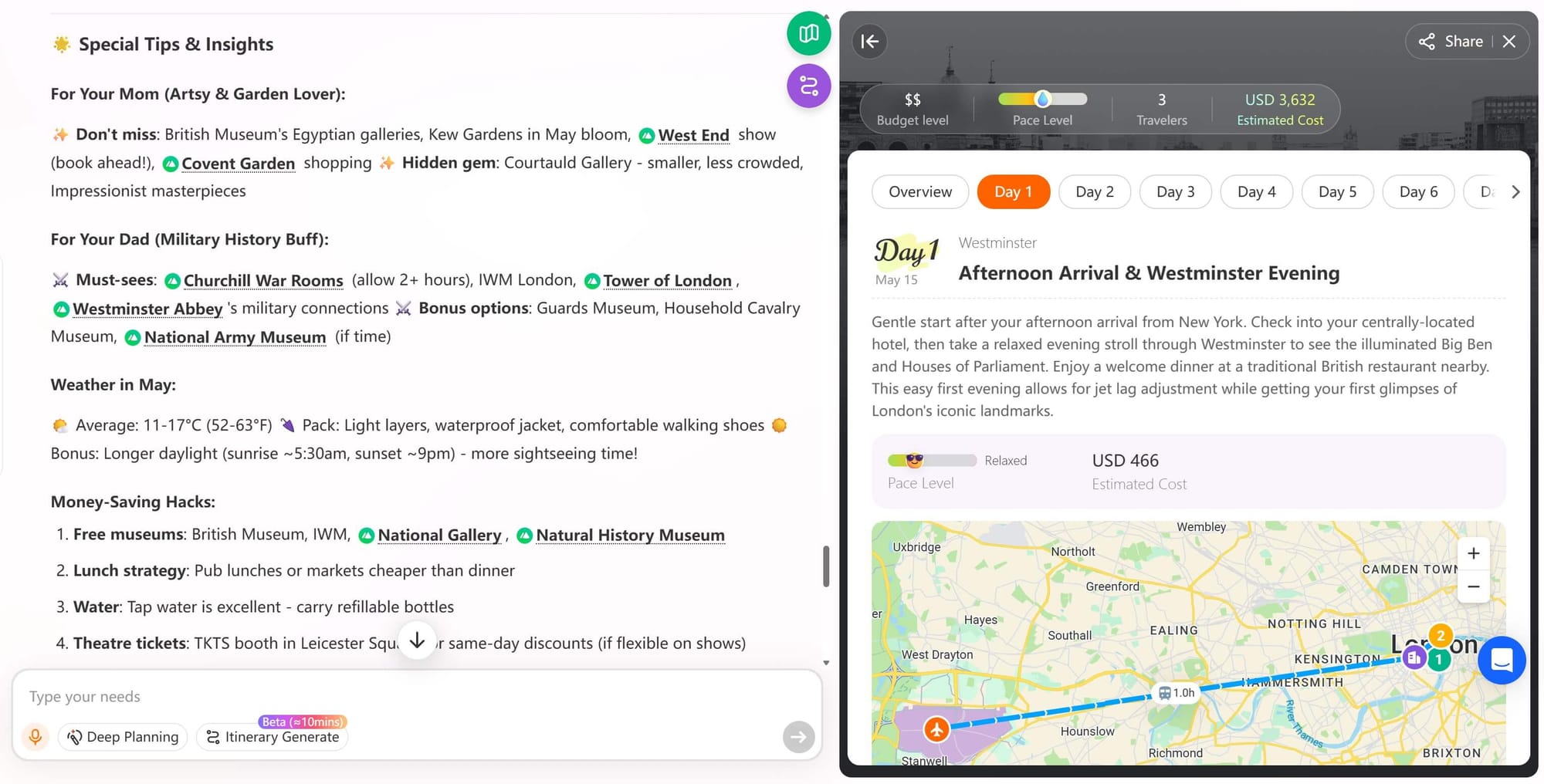
Here is the week-long London itinerary that beautifully balances mom's artistic interests with dad's passion for military history.
Where to Stay in London
Where to stay in London depends on your preference and budget. Do you want to experience the central actions and top things to do, or explore cultural landmarks like museums and parks? Is convenient transportation more important to you or a quiet and uncrowded environment? Below are the areas we listed for travelers with different needs.
For first-time Visitors and Central Explorer
Holborn is one of the best areas for first-time visitors to stay in, and is considered the heart of London. Stay here, you can experience all aspects of London, from traditional meals to London fashion. Covent Garden is also a great bet for tourists with a sufficient budget. There are a lot of things to see and do, and just around the corner from Soho, Holborn (British Museum), Strand, and Trafalgar Square.
For Culture Experience and Parks
Kensington and Chelsea have world-class museums like the Victoria and Albert Museum and the Natural History Museum, and also charming streets with a village-like atmosphere. And Notting Hill, known for its iconic pastel houses, offers a mix of history, fashion, food, and arts, ideal for walking tours, exploring, and soaking up London's vibrant culture.
For Trendy and Local Vibes
Shoreditch, a vibrant block in East London, blends street art, local food, and diverse activities for nightlife. It's also famous for trendy eateries and galleries, like Pure Evil Gallery and Hales Gallery. And Dalston, which is close to Shoreditch, has a strong local vibe. As the hub of experimental music and late-night venues, and is known as "London's Brooklyn".
For Transport and Convenience
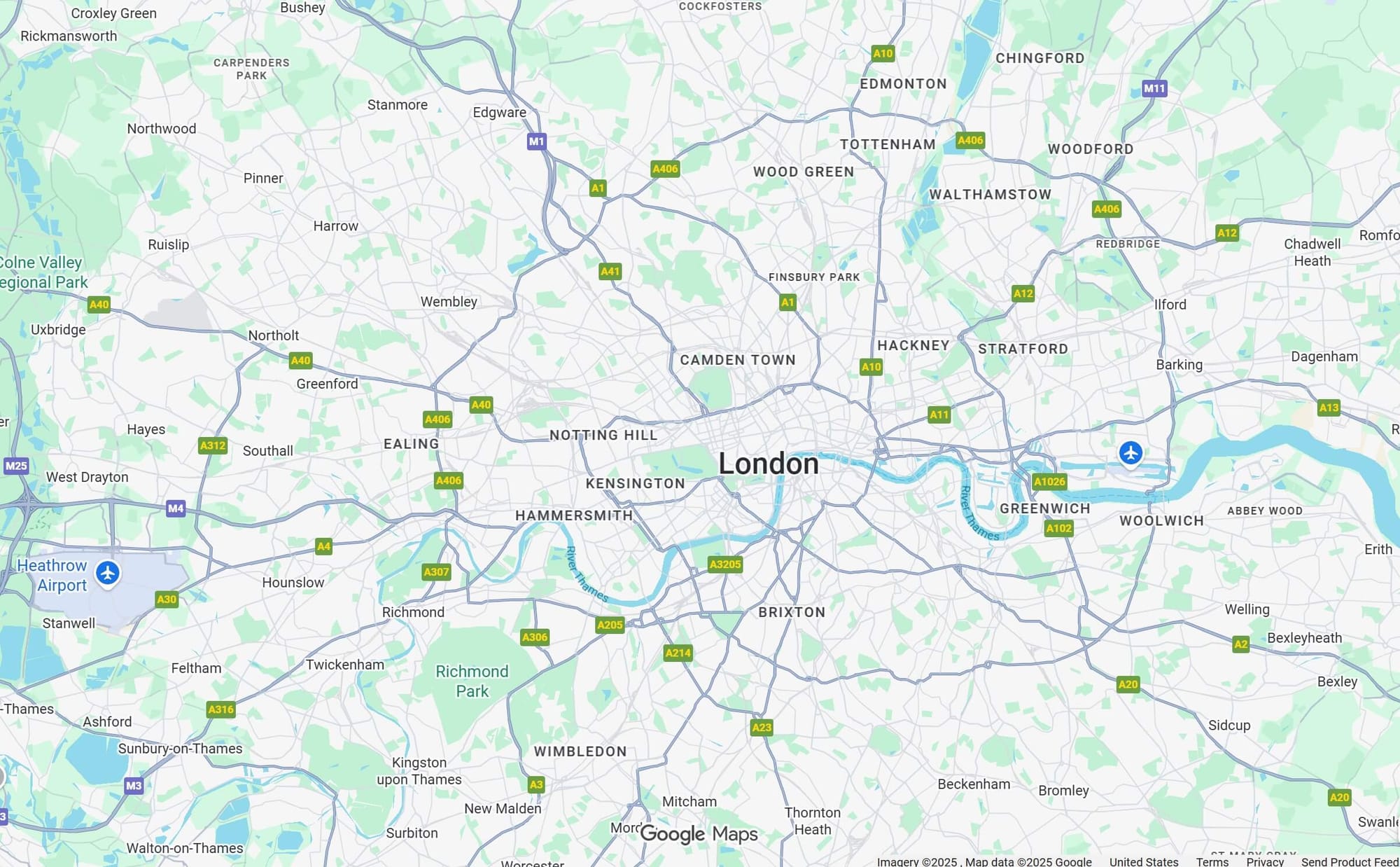
Paddington is convenient with the Elizabeth Line and Heathrow Express linking to Heathrow Airport. There are also many wonderful hotels that provide canal walks, an ideal area for recommendations. King's Cross, a major rail hub, is another convenient option. It is close to St Pancras, making it easy to take the Eurostar. Ideal for visitors who need convenient transportation.
Top Things to Do in London
Route 1: Classic London Landmarks for First-Time Visitors
🚩Buckingham Palace → Big Ben → The London Eye
- Buckingham Palace
The King's official London residence is a working royal palace. A ticket is required to visit Buckingham Palace. But you can watch the Changing of the Guard ceremony for free. Please verify the timetable on the official website in advance, as it could change.
- Big Ben
The most famous clock in the world. And also one of the most Instagrammed landmarks of London. Tickets to explore the inner workings of the clock should be bought in advance.
- The London Eye
Located on the South Bank of the River Thames. With an impressive 135 metres tall, it is one of Europe's tallest observation wheels. On top, you can enjoy unparalleled 360-degree views of the capital, and an admission fee is required.
Route 2: A Day of Art, Shopping, and Theatre in London
🚩The British Museum → Covent Garden → The National Gallery → London’s West End
- The British Museum
A comprehensive national museum located in London with particularly outstanding holdings in archaeology and ethnography. It's free to enter, and you can experience cultures across the world, from the dawn of human history to the present here.
- Covent Garden
Located in the West End of London, famous for its luxury fashion, beauty stores, award-winning restaurants, and theatres. A good place for shopping and dining.
- The National Gallery
An art museum in Trafalgar Square in the City of Westminster, which contains over 2300 works, including the national collection of paintings in the Western European tradition from the 13th to the 19th centuries.
- London’s West End
A vibrant cultural hub that is considered the fashionable end of London. There, visitors can watch musicals like The Phantom of the Opera and The Lion King at the end of the day.
Route 3: for History, Food, and Shopping in London
🚩Tower Bridge → Borough Market → Oxford Street & Regent Street
- Tower Bridge
Tower Bridge is a marvel of Victorian-era engineering, which took almost 430 construction workers over eight years to build (1886–1894). It is an incredible feat of Victorian engineering.
- Borough Market
It's one of London's oldest and largest food markets, dating back to at least the 12th century. Visitors can buy specialty foods here. It is a delicious lunch stop.
- Oxford Street & Regent Street
For many people, shopping is a top reason to visit London. On Oxford Street, you can find most of the flagship stores of the UK. And from Oxford Street, you can easily get to Regent Street on foot. You can find a wide range of luxury goods here.

Transportation Tips for London
To get around London just like a Londoner, please take a look at this transport guide.
City Transportation
- Underground: There are 11 lines connecting the suburbs to the city. The simplest way is to use your contactless card or smartphone at the ticket barriers, and the fare will be calculated automatically.
- Bus: Although not the most convenient way to get around London, it is still very popular among visitors. Compared to underground, visitors can enjoy the city sights during their journey.
- Cycling: A healthy and environmentally friendly way of traveling. Santander Cycles is a rental service overseen by Transport for London. It costs £2 per 30 minutes, and you can find them easily across the city.
- Boat: It may not be the most convenient or cost-efficient way to get around, but it's definitely the most interesting way to enjoy the unique views of sights like Big Ben and Tower Bridge.
Tips: You can buy Oyster cards for public transport in London. It is an electronic smartcard that you can use on the Tube, Elizabeth line, buses, Docklands Light Railway, Uber Boat by Thames Clippersriver bus service, London Overground, TfL Rail, and most National Rail services in London.
Getting To and From the Airport
If you come from within the UK, taking a train is a good choice. If you come from European cities like Paris, Brussels, and Amsterdam, you can take the Eurostar, which can take you straight to St Pancras International station.If you fly to the UK, there are also easy ways to get to London. From Gatwick, you can take a train to London Bridge, Victoria, or Blackfriars. From Heathrow, the Elizabeth Line can take you to the city centre. From Stansted, the quickest way is also the train. The Stansted Express runs every 15 minutes. From Luton, the trains can take you to multiple London stations. And in peak times, it runs every 10 minutes.
Final Thoughts
Planning a trip to London can be overwhelming because the city has so many attractions and experiences spread across different areas. From iconic landmarks and world-class museums to markets, shopping streets, and theatres, there is something for everyone, but organizing it all can be time-consuming. If you want a personalized, editable day-by-day itinerary for London, try iMean free AI trip planner.