
If you are planning a trip to Thailand, you will need this Thailand travel planner. It's not because Thailand is difficult to travel to, but because it is incredibly tourist-friendly, with an overwhelming number of attractions and Places to visit in Thailand to choose from. Unlike regular trip planner websites, our best AI trip planner, iMean AI, can actually understand your style and build a real plan you can use instead of pushing pre-packaged routes.
So here’s the simple, step-by-step roadmap according to my practical experiences and iMean AI's recommendations.
Best Time to Visit Thailand
This tropical country has only three distinct seasons, making it a great place to visit any time of year. Basically, I can tell that November to March is the high season for travelling, July to September is the low season, and April to June and October are the shoulder seasons.
- Dry Season
In terms of weather, it is typically warm all year round, but November to February is considered the best time to travel to the majority of the country. November marks the beginning of the dry season. Expect an average daytime high of 28.9°C (84°F).
- Hot Season
March to May is the hot season. Think warm beach days but long, sweaty afternoons in the city. April is the hottest month in Thailand before the country moves into the wetter season from May through October, while the capital is less crowded than usual, and the beaches are typically jammed with Bangkokians seeking reprieve from the heat. Meanwhile, temperatures in the usually temperate north soar to 36°C (97°F).
- Rainy Season
Thailand’s rainy season(June to October) is long, but it doesn’t necessarily mean non-stop torrential downpours. Monsoon rains, especially before July, are typically violent but short, usually arriving in the early evening and lasting for 20 to 30 minutes. Luckily, Thailand’s location means it avoids the strong typhoons experienced by Vietnam and the Philippines.
- How Many Days Do You Need?
It depends on your pace. Universally, 7-10 days is great for a taste, covering Bangkok + one region (North for culture/Chiang Mai or South for beaches like Phuket/Krabi); 14 days allows for a classic loop hitting Bangkok, North (Chiang Mai), and South islands/beaches; and longer trips (2+ weeks) let you explore more deeply or stay put.
For short trips, focus on one area, while longer trips benefit from internal flights to connect regions like the north (Chiang Mai) and south (Andaman Coast/Gulf islands).
How to Plan Your Trip with an AI Trip Planner
Here's how I plan my trips with iMean AI, which feels closer to a real travel buddy than software, basically the closest I’ve found to the best trip planner that stays objective and flexible.
Step 1: Start with the basics
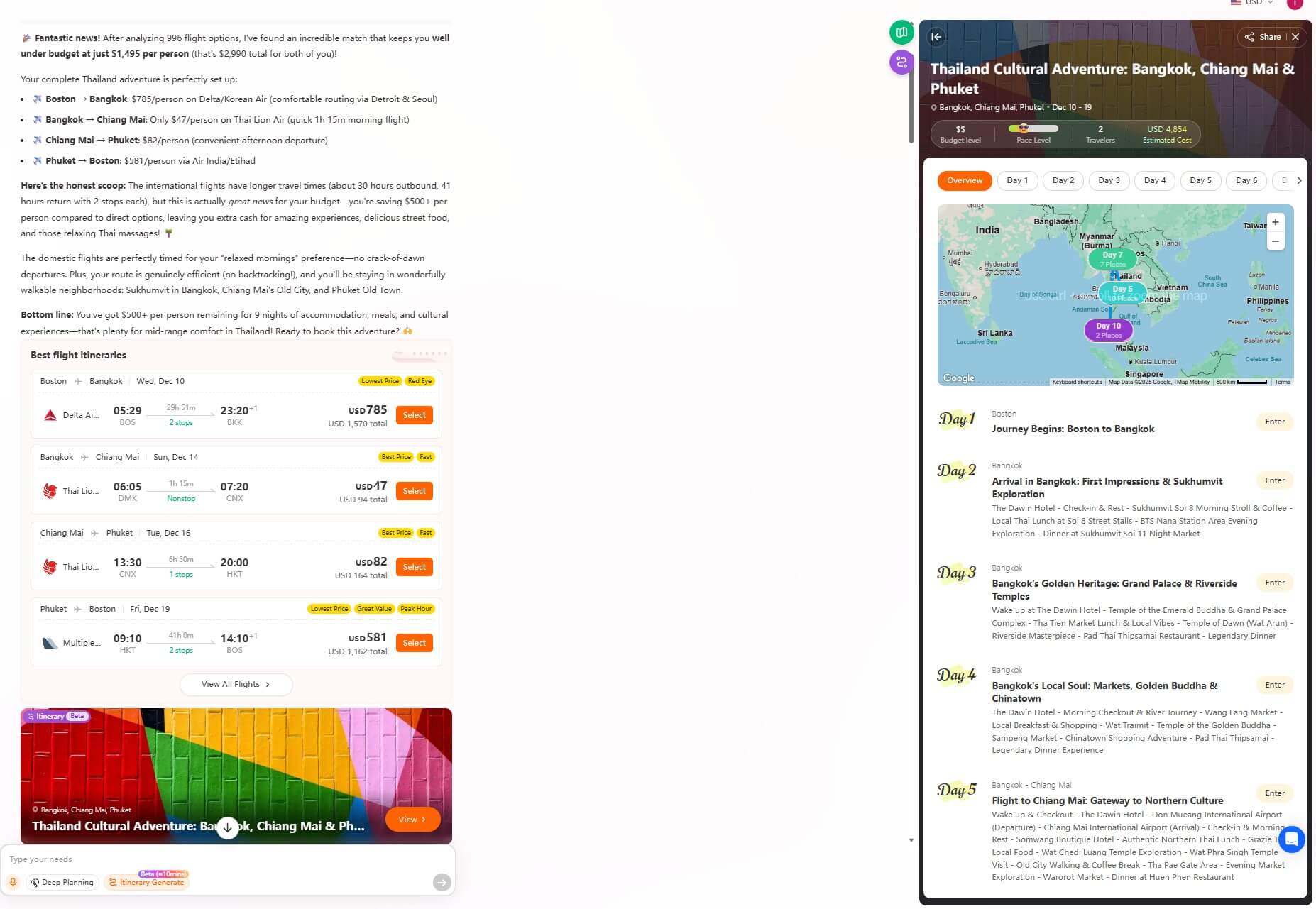
You can begin by telling the tool your travel dates, where you're coming from and going to, how many days you want to spend, and what you care about(budget, anything to avoid or pursue, etc.). The planner uses this information to understand your priorities and begin shaping a route that actually makes sense on the map.
Step 2: Get your full itinerary
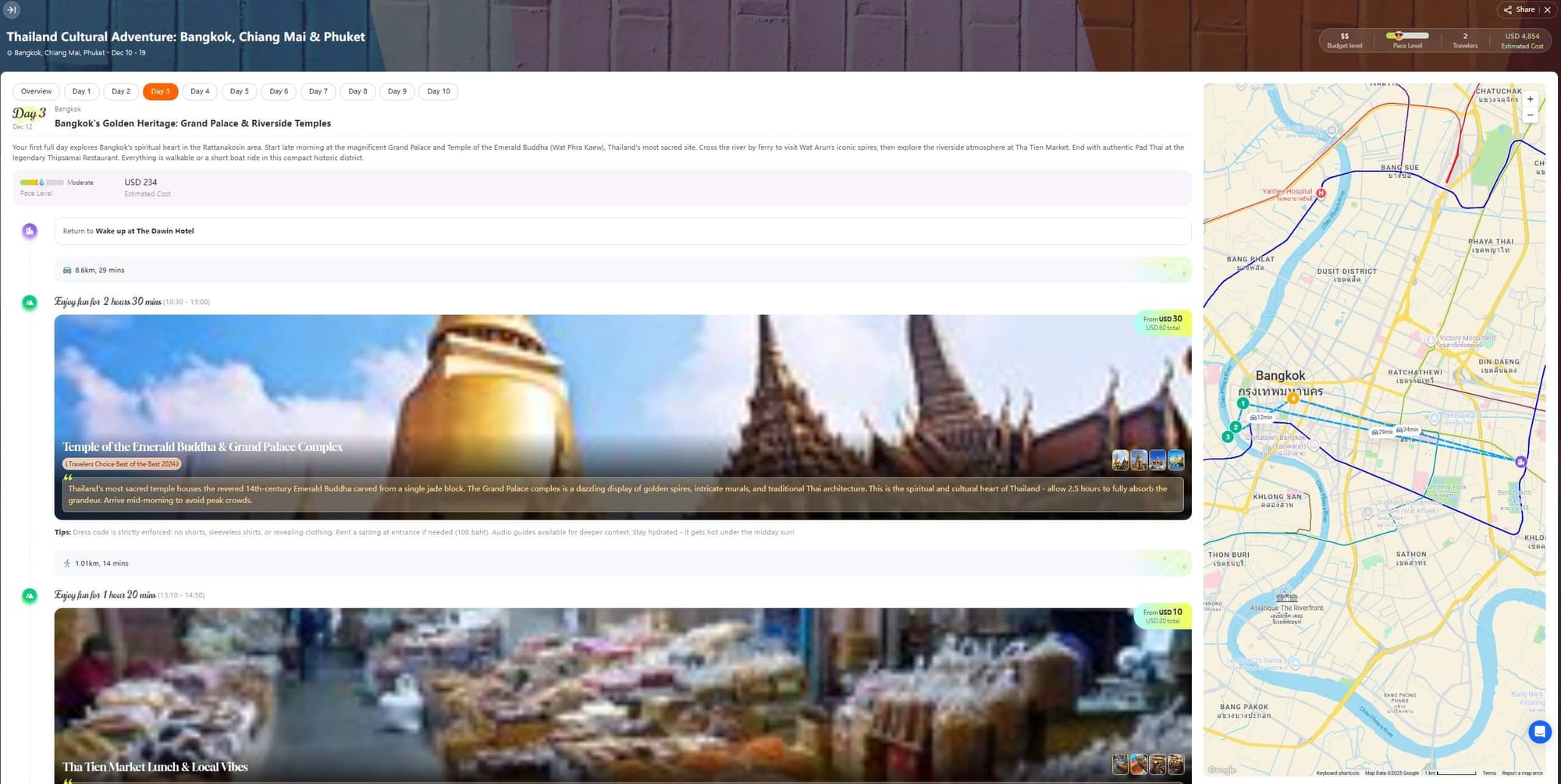
A few minutes later, iMean AI returns with a complete itinerary that usually covers everything. It organises your trip into a day-by-day itinerary, along with realistic travel times, so you know what each day will feel like. What's more, it will screen out the cheapest flights and hotels that meet your requirements and provide valid booking links.
Step 3: Edit your itinerary and export it
Once you’ve reviewed the plan, you can adjust anything, like shorten stays, add an island, or ask for alternative options. After everything looks right, just export the Thailand itinerary with a shareable link so you can bring it on your phone for easy reference.
Where to Stay in Thailand
Thailand’s cities and islands each have their own rhythm. To make this simple, I’ll break down the areas travellers use the most and what type of traveller they fit.
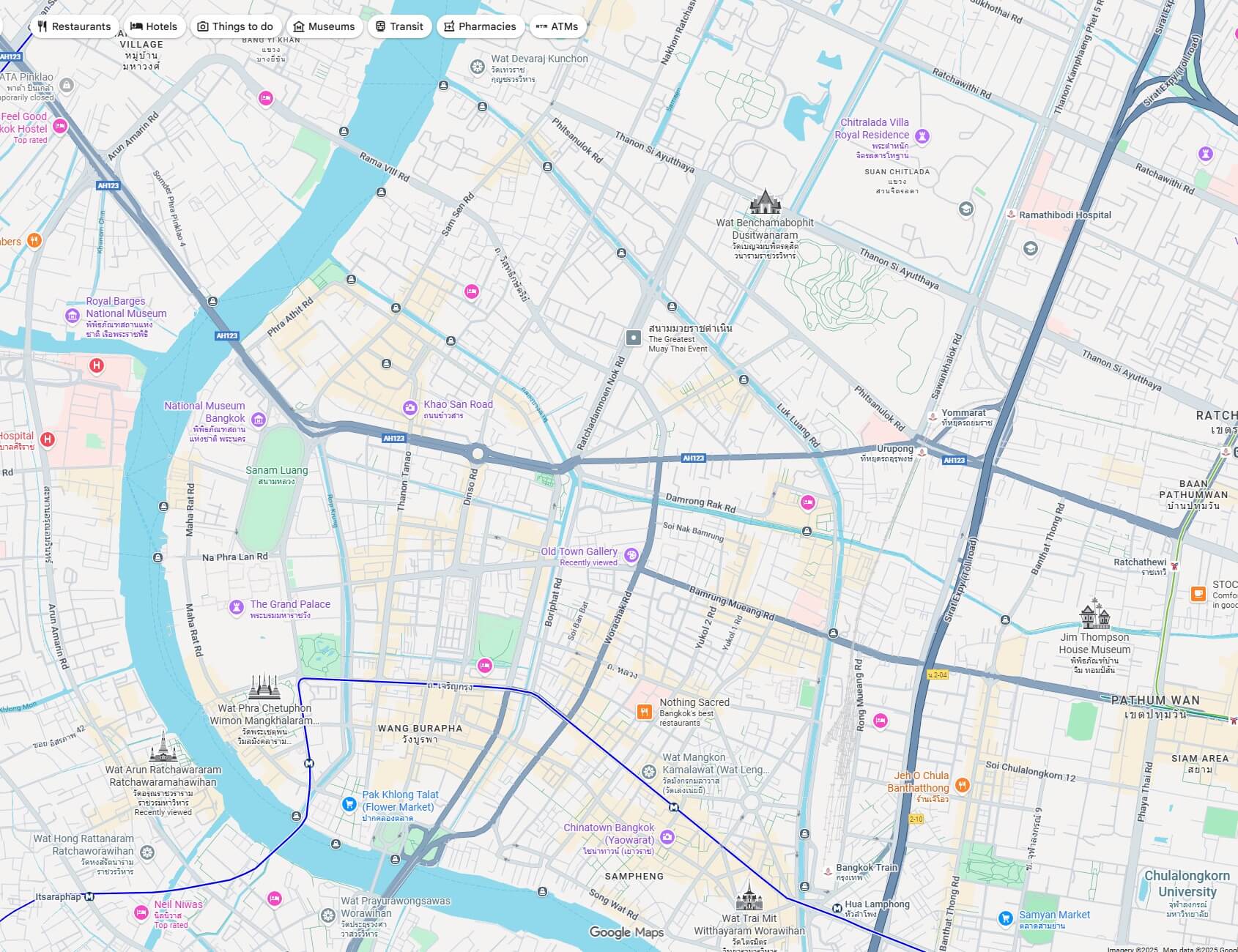
Old Town, Bangkok
The old town area is located in the west of Bangkok. It has great street food, and Lots of good restaurants here as well. Yaowarat/Chinatown is there, offering fantastic Thai-Chinese food. There are a few bars around, and the famous Khao San Road is here too. I love going to old coffee shops like Kopi Hya Tai Kee near the Giant Swing and On Lok Yun near the Old Siam.
The Grand Palace and old temples are mostly nice. If you like history, Museum Siam and the National Museum are a must-visit. Apart from the Grand Palace area, where you’ll find some tourist scams, I think people here are pretty friendly. There’s a sense of community since it’s one of the oldest areas in Bangkok. The neat area is pretty suitable for people who love nice food and culturally interesting experiences.
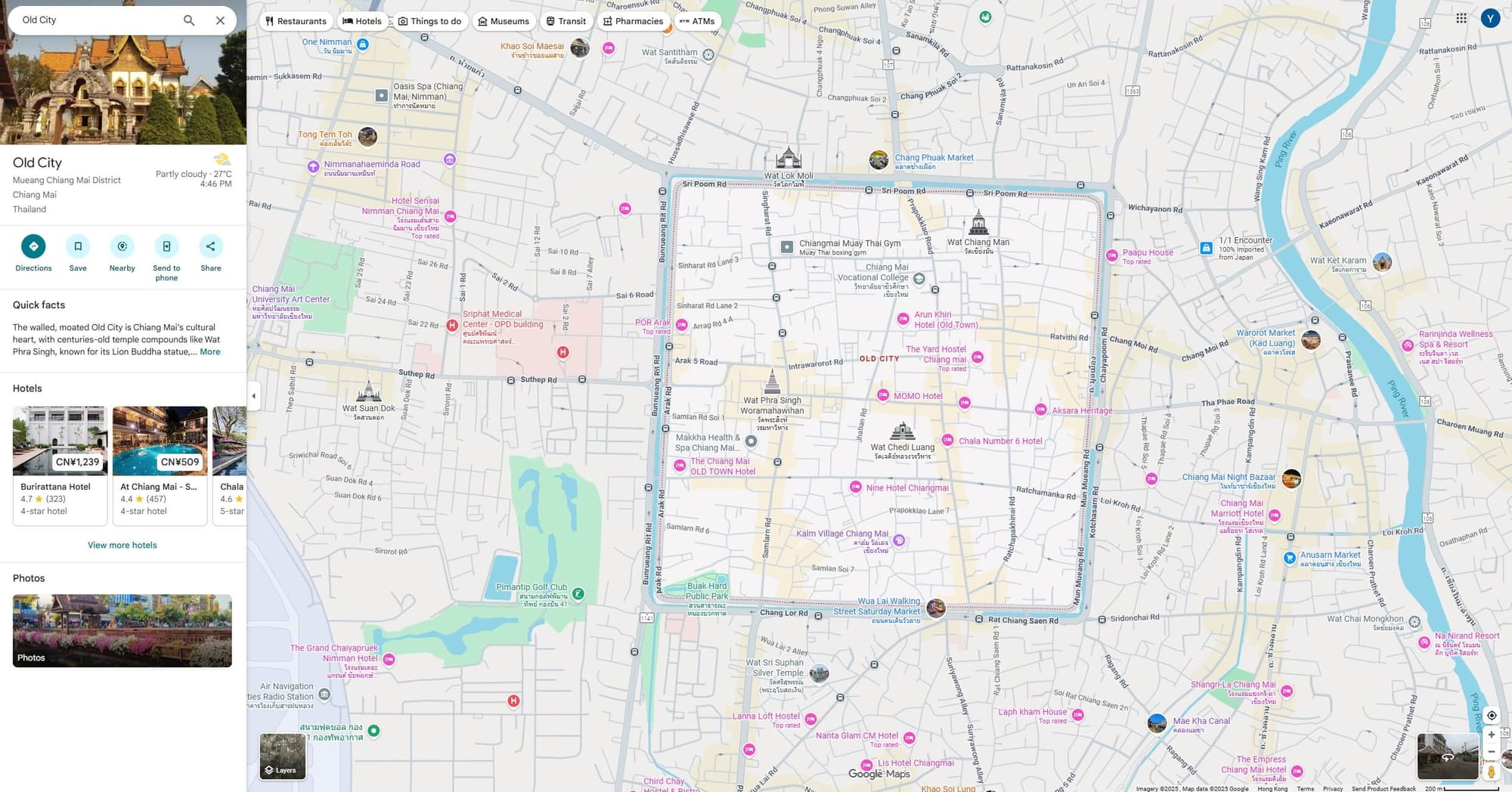
Old City, Chiang Mai
The Old City of Chiang Mai is a historic district and is a large part of the city center today. While things are relatively modern today, the Old City is where you’ll experience most of Chiang Mai’s cultural charm. What's more, it’s a great home base if you like exploring on foot or if it’s your first time visiting the north. It’s quieter at night and easy to navigate. It's perfect for travellers who like exploring without constantly checking their phone.
Staying here also means you can reach Chiang Mai’s biggest attractions without long transfers: Doi Suthep is a short ride away, the Sunday Walking Street Market starts right here, and most cooking classes or elephant sanctuary tours arrange easy pickup from hotels inside this area. It’s a comfortable base for travellers who want a balance of authenticity and convenience.
Kamala, Phuket
Kamala is ideal if you want beach life in a balance of not being too crazy but not too quiet. The beach is surprisingly peaceful, especially in the morning. Compared with Patong, Kamala offers a more relaxed way to experience Phuket. You still get clubs and restaurants, but everything feels slower and more spread out. There is only a short taxi ride from Patong if you want to sample the wilder nightlife there.
It’s also a practical base for day trips: you can reach Surin Beach in just a few minutes, and boat tours to Phang Nga Bay or the Phi Phi Islands typically include pickup from Kamala hotels. Families, couples, and anyone looking for a calmer coastal stay tend to prefer this area, especially if they want ocean views without sacrificing comfort or accessibility.

Top Things to Do in Thailand
Route 1: Bangkok → Ayutthaya → Chiang Mai
This route follows a natural northbound line, starting in Bangkok’s dense, high-energy cityscape before shifting into the historical calm of Ayutthaya and ending in Chiang Mai’s mountainous culture hub.
Most travellers begin in Bangkok, not only because the city has the largest international airport, but also because it helps you ease into Thailand’s rhythm. From there, taking a short train ride to Ayutthaya offers a welcome change of pace, with its ancient temples and serene river views. Instead of flying directly north, you can enjoy spending half a day here before catching an affordable flight or overnight train to Chiang Mai.
Route 2: Phuket → Phi Phi Islands → Krabi
If you’re looking for an island-hopping route that doesn’t involve long transfers, this southern loop is one of the easiest to follow.
Most visitors land in Phuket first for the most flight options. Starting here, you can enjoy beaches, viewpoints, and nightlife while adjusting to the tropical climate. From Phuket’s pier, boats depart frequently to Phi Phi Islands, making it a natural midpoint where you can spend a day swimming, snorkelling, or simply taking in the dramatic limestone cliffs. Ending in Krabi strikes a perfect balance, giving you a more relaxed, nature-focused finale before heading home.
Route 3: Chiang Mai → Pai → Mae Hong Son
This northern route is ideal for travellers who want something different from the typical beach itinerary. Each stop becomes more remote and peaceful, giving you the sensation of travelling deeper into northern Thailand rather than simply moving from one sightseeing spot to another.
Starting in Chiang Mai gives you access to night bazaars and Buddhist temples, but it also works as the gateway into Thailand’s mountains. From there, the drive to Pai gradually pulls you into a slower lifestyle. Continuing west toward Mae Hong Son ties the journey together with one of the most scenic loops in the country.
Transportation Tips for Thailand
Transportation can be surprisingly smooth once you know how things fit together. Here’s everything you need in one place.
City Transportation
Bangkok has the most developed urban transit system in the country. The BTS Skytrain and MRT subway make it easy to skip traffic. Taxis and ride-hailing apps work well but can be slow during rush hour. Walking is enjoyable only in certain districts; many sidewalks are uneven or crowded.
Chiang Mai and Phuket rely heavily on cars. Songthaews (shared red trucks in Chiang Mai) are common, and ride-hailing works fine. In coastal regions, scooters are popular, but I don’t recommend renting one unless you’re confident on two wheels. Renting a car is an option, especially on islands where distances are long, but driving in Bangkok is stressful even for experienced drivers.
Intercity Transportation
Thailand connects its major cities through several easy options:
- Flights: The fastest way to travel between Bangkok, Chiang Mai, and Phuket. Frequent and straightforward.
- Trains: Scenic and popular in Bangkok–Chiang Mai. Overnight trains are comfortable and relaxing.
- Buses: Budget-friendly for medium distances, though longer travel times.
- Rental cars: Good for northern loops or coastal routes, but not ideal for busy cities.
Flights are usually the simplest, especially when island-hopping.
Passes & Cards
Bangkok uses the Rabbit Card for the BTS, which saves time but isn’t essential if you’re only riding a few times. The MRT has its own stored-value card. Most other cities don’t have unified systems, so you’ll mainly rely on cash or mobile payments。
Final Thoughts
Thailand is rewarding, colourful, and more varied than most first-time travellers expect. To build a smooth, day-by-day plan you can adjust whenever you need, iMean AI is here to really help keep things simple.
If you want a personalised, editable day-by-day itinerary for Thailand: