
"Five days of free time, let's go on a trip!"Plan the itinerary first, then book hotels and flights."All these recommendations… Where exactly are they? I need Google Maps."Oh my god, flights and hotels are almost over budget, maybe connecting flights would be cheaper."Wait, where is that blogger's recommendation? I've been through over 20 websites already…"Actually, when planning a trip, most people do not lack info; they lack help in making sense of it.
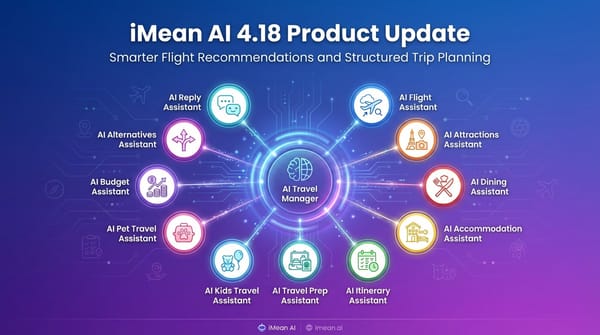
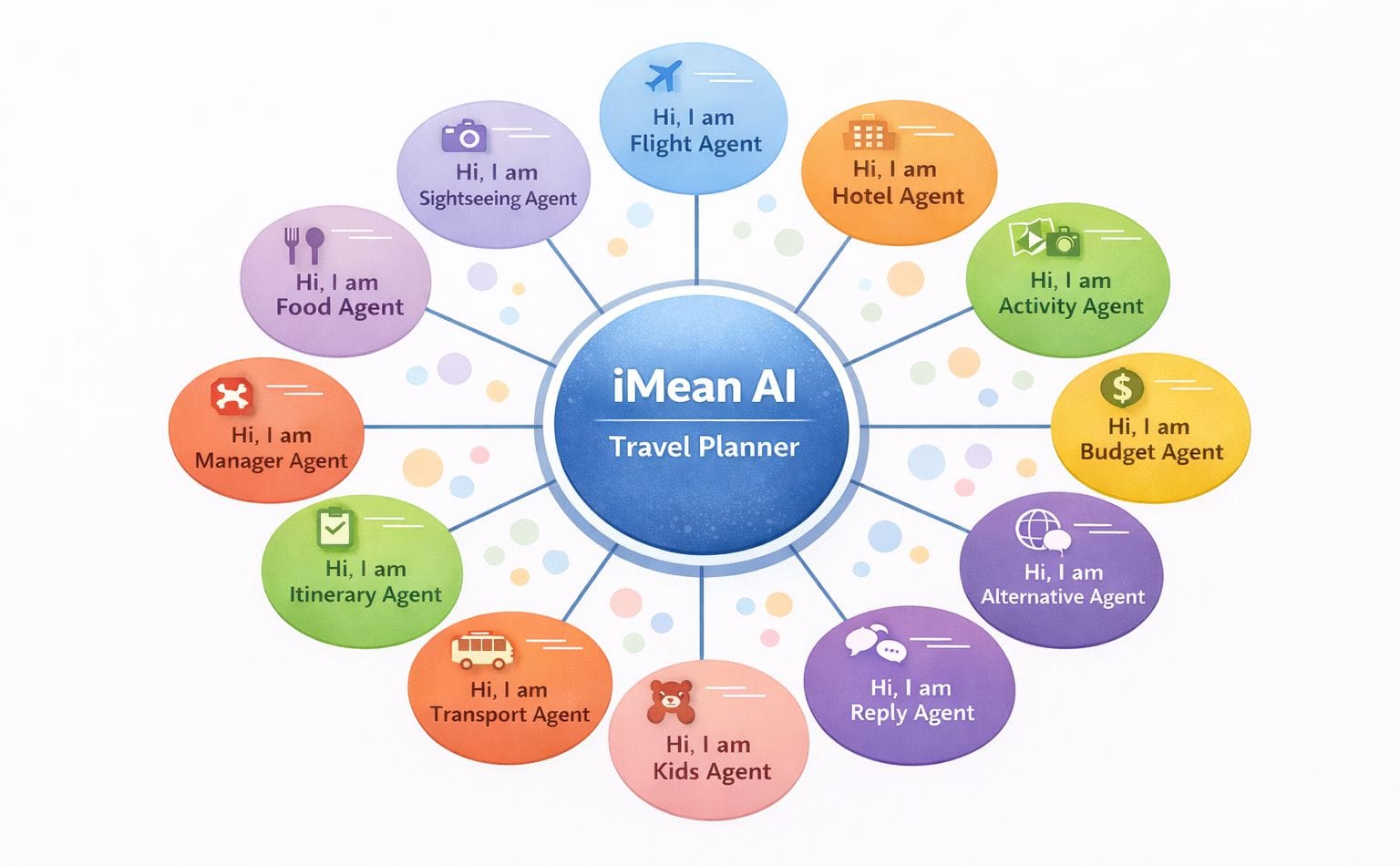
Especially when traveling with kids or pets, the planning can be more overwhelming. Many travelers turn to AI tools. What does it feel like using an AI trip planner? Most of these feel like a chatbot that just replies. This is where iMean AI is different. It uses 12 specialized AI agents working together to plan your trip.
The Big Shift: From "One AI" to "A Team of AI Specialists"
Travelers turn to AI when travel planning gets complicated. Most AI travel planner tools, however, still feel like "a chatbot that replies." As your needs get more complex, it starts to feel like the AI gets overwhelmed, too. But the reality is different with iMean AI. This AI itinerary planner handles users' diverse needs with 12 AI agents, like a travel manager and a team of specialists. Whether you travel with kids or pets, want a multi-destination trip, or plan a themed trip without anything specific in mind, the 12 agents can make sense of it all.
What It Actually Feels Like
You don't need to repeat your needs or restate what you have input over and over again. With 12 AI agents, the system remembers everything and shows you a structured overview of your plans, even things that you didn't think of. iMean AI trip planner gives you a completely new experience.
Before: scrolling, guessing, worrying
For most AI tools, users keep scrolling to find the information they need or guess what the next step is with their own experience, because of unclear information. When needs are complex, they may miss detailed information or forget to take users' needs into consideration, even generating AI hallucinations that make the itinerary unreliable.
Now: clarity, priorities, confidence
What can AI do for travel planning now? Its answer is clearly structured. Users can find the information they need with the fixed navigation bar at the top conveniently. The requirements and preferences that users input are accurately identified and assigned to different AI agents. Restaurant agent, accommodation agent, pet agent, child agent, budget agent…All of them work together to create the most clear and reliable itineraryfor you.
Concrete Moments Where It Really Matters
Planning a trip involves many small decisions that can make a big difference. From keeping a child happy to traveling with a pet to balancing work while exploring, these are the moments where guidance matters most. The examples below show how the 12 AI agents of iMean AI help travelers handle preferences, logistics, and challenges to create trips that feel effortless and personalized.
Kid-Friendly California Family Trip
How to plan a stress-free family trip with AI? Here's a real-world example.
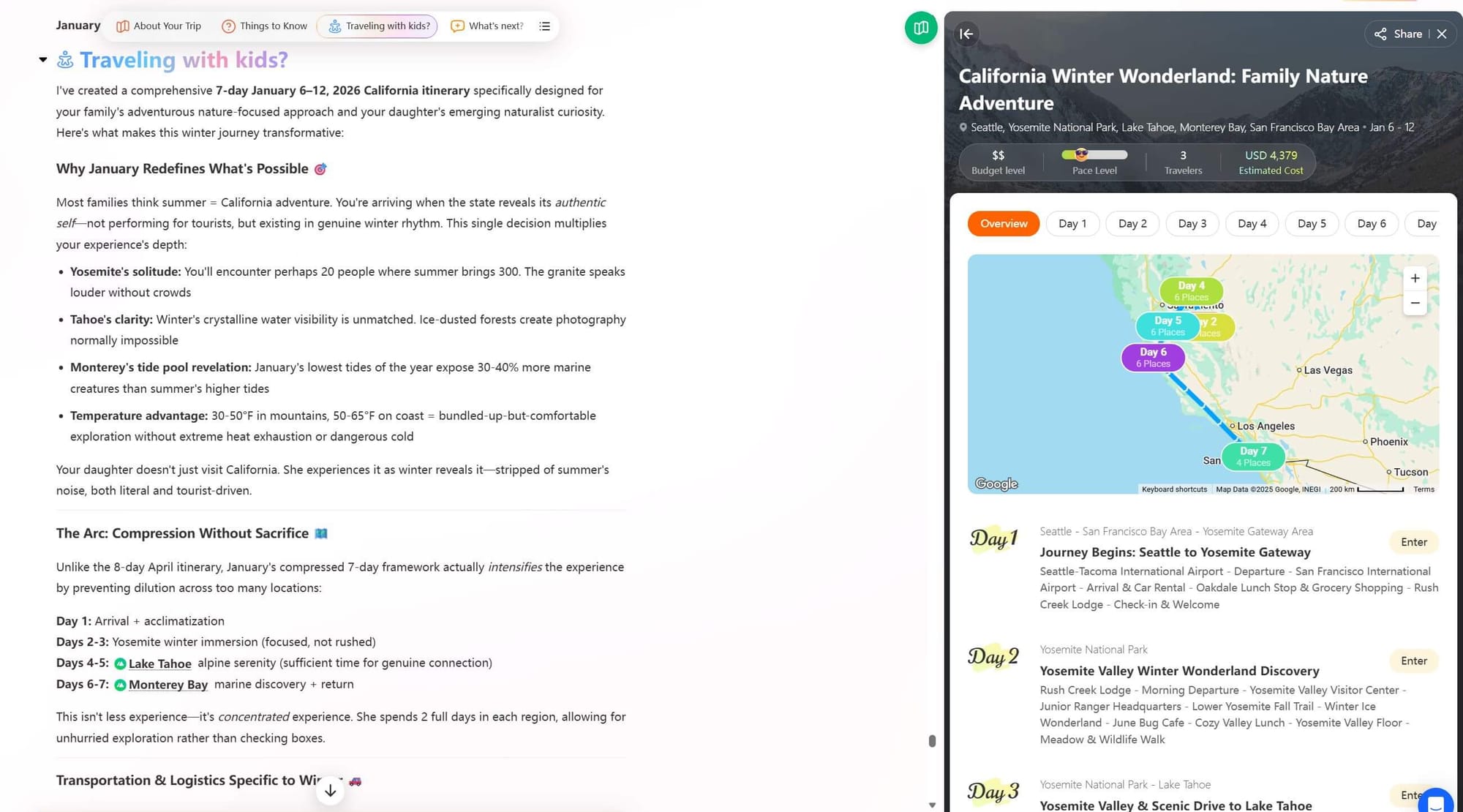
My wife and I love national parks, hiking, and adventurous trips, but this will be our first trip with our 7-year-old, from Seattle, Washington State, to California. She is too young for intense outdoor activities such as long-distance hiking. Also, she doesn't like crowds, etc, so Disney or something similar is out. Museums aren’t a good option either, as they don't have the attention span or interest for museums yet. Please help me plan a route that feels comfortable and realistic. The hotel should be kid-friendly, and I prefer direct flights with short travel times.
Highlights: The AI agents of iMean AI accurately identify the girl's preference and the users' flight choices, and recommend direct flights along with easy and uncrowded activities like gentle hikes or visits to aquariums. Also, it points out things you should know about this trip, like the weather in January. Here is the itinerary for the California family trip with a kid.
Pet-Friendly Alpine Road Trip
How to plan a pet-friendly trip with AI?Here's a real-world example.
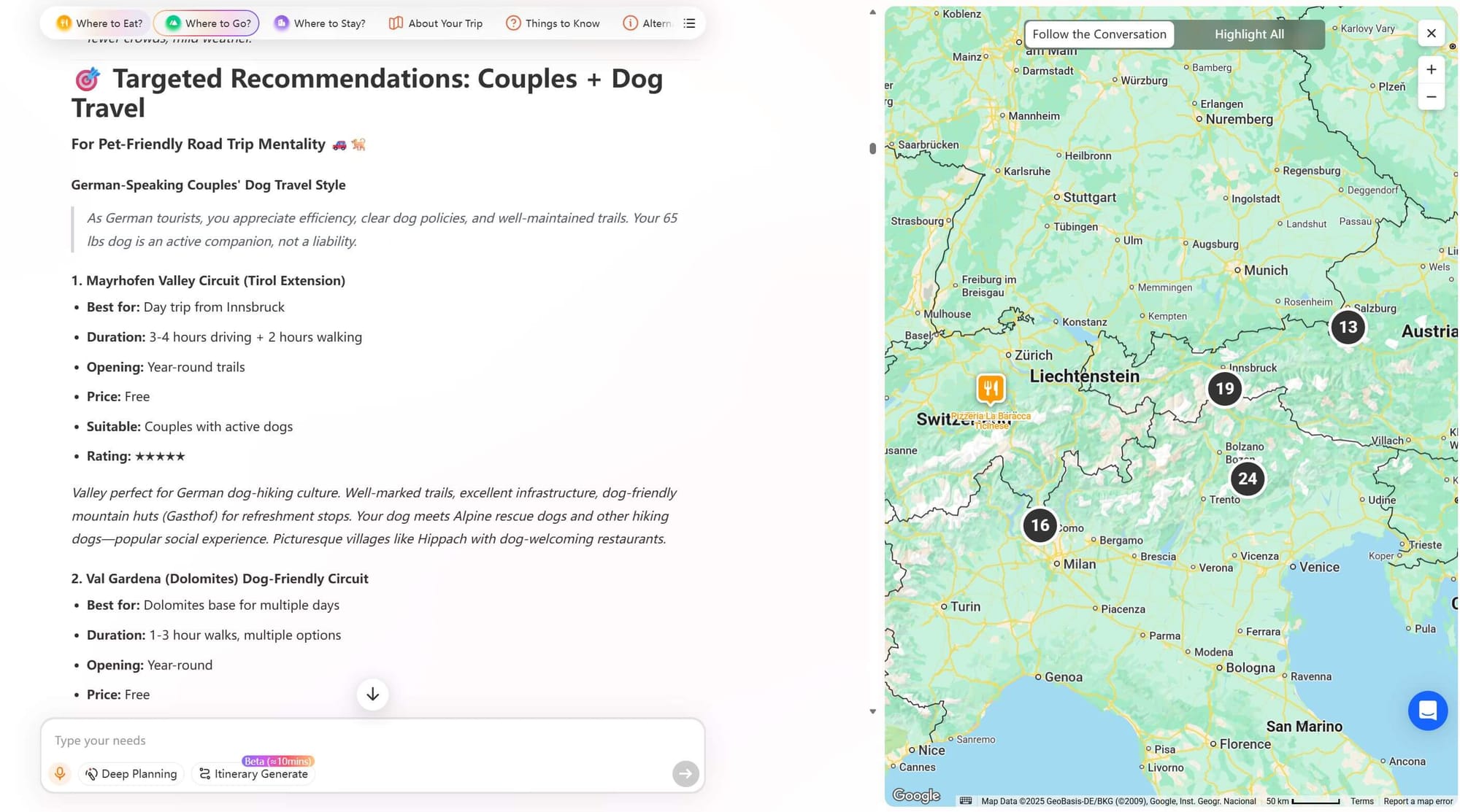
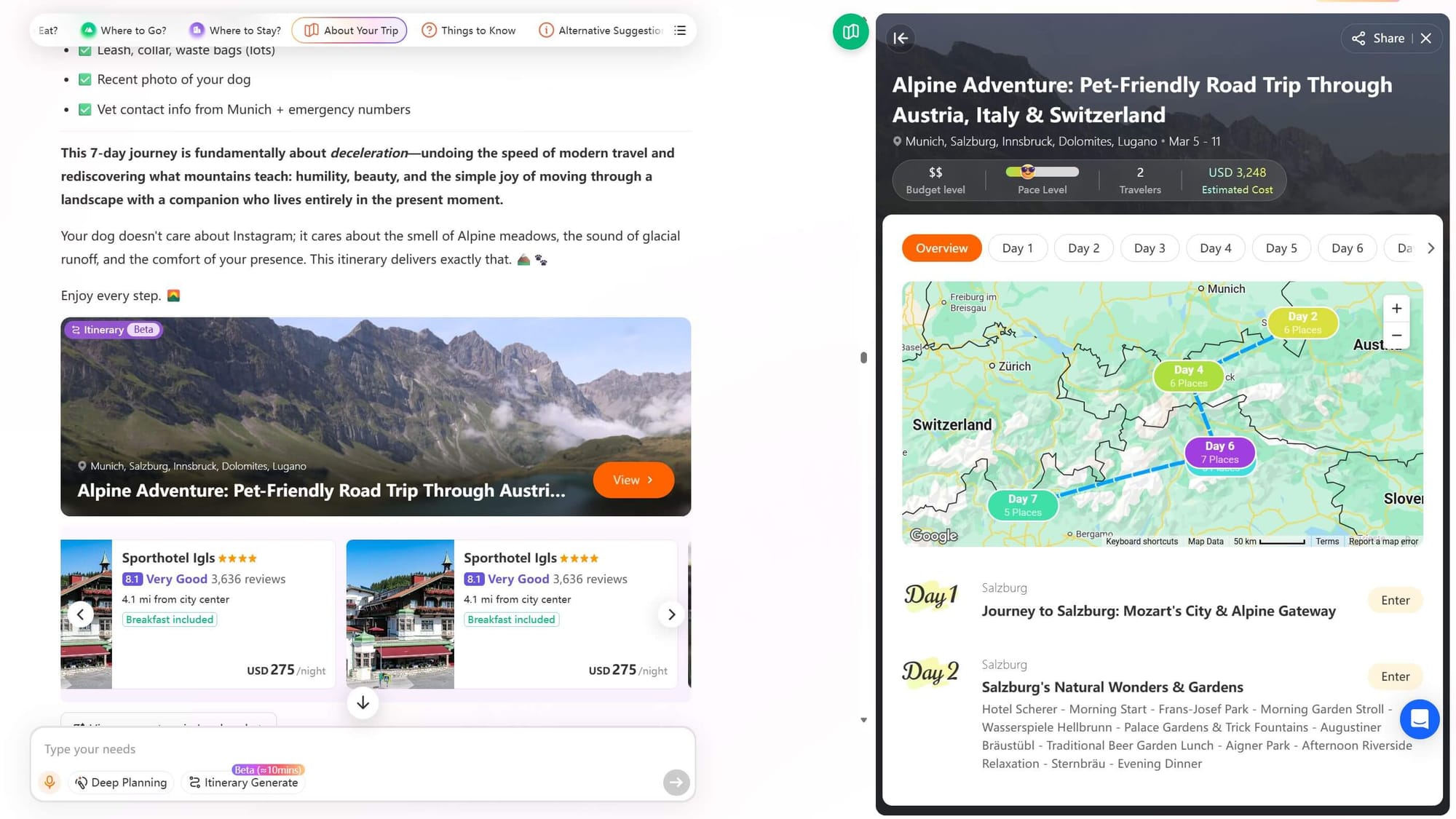
We are a couple from Munich, Germany. We love natural landscapes and want to have a slow, comfortable road trip with our 65 lbs dog for 7 days in March. Our basic route: Munich → Salzburg → Innsbruck → Dolomites (Italy) → Lugano or Lucerne (Switzerland) → Munich. Please plan a trip with pet-friendly activities. Our dog stays with us in the hotel at night. Let me know if there's anything I need to be careful about.
Highlights: The pet agent of iMean AI takes good care of the 65 lbs dog and arranges both couple and pet-friendly hotels and activities for them. Just like the AI said," Your dog doesn't care about Instagram; it cares about the smell of Alpine meadows, the sound of glacial runoff, and the comfort of your presence." Check the itinerary for a pet-friendly road trip.
Digital Nomad Europe Journey
How to plan a digital nomad solo-trip with AI? Here's an real-world example.
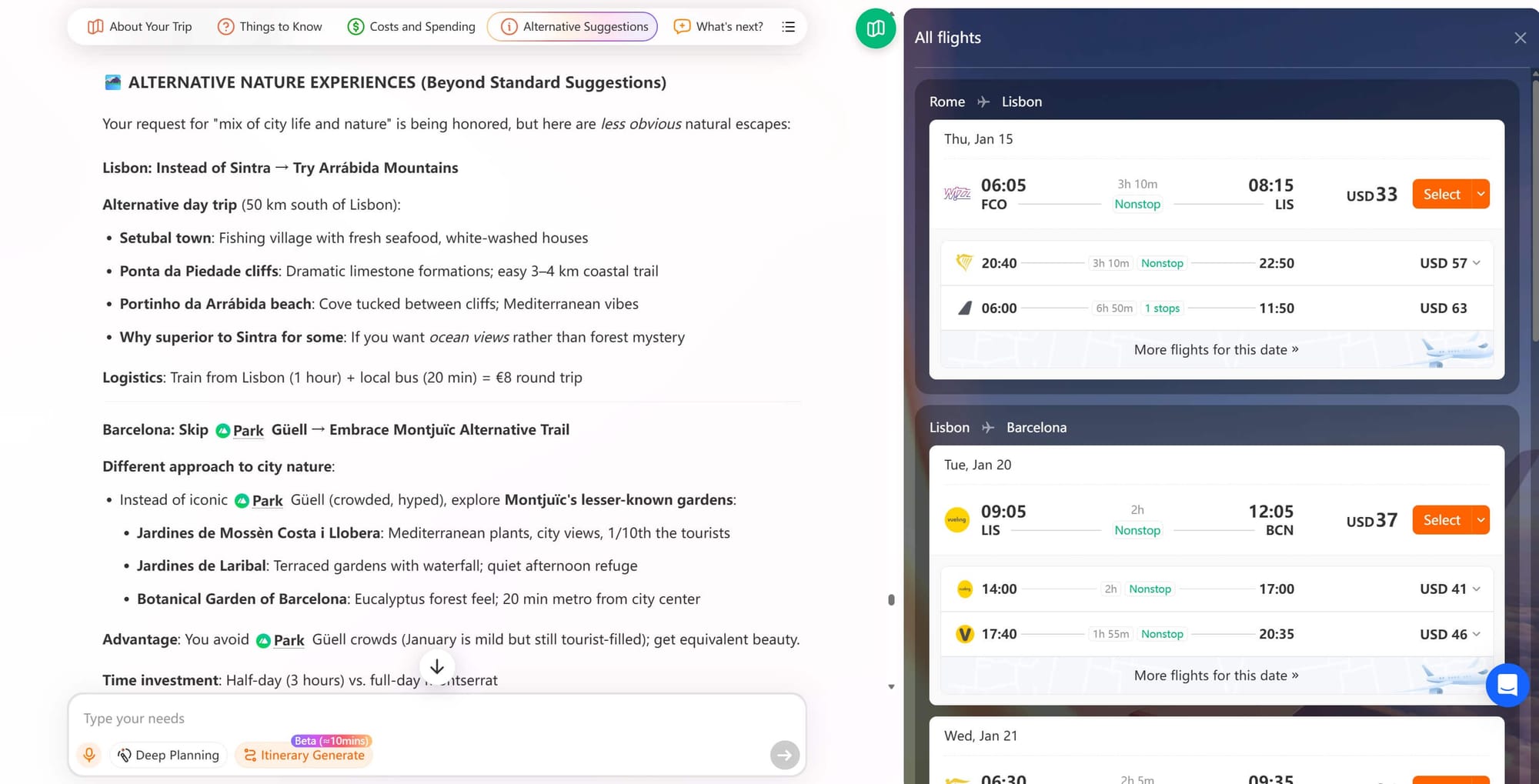
I am Luca from Italy. I’m planning a three-week trip from January 15 to February 4, starting in Lisbon and ending in Berlin, with a stop in Barcelona. My budget is around $4000. I work remotely, so good Wi-Fi and cozy places near cafes or coworking spots are essential. I want a mix of city life and nature, like parks, coastal walks, and some easy hikes. I prefer direct flights, and my goal is to balance work and the trip.
Highlights: Digital nomads don’t chase landmarks. They choose places where life and work can quietly coexist. Since the calendar has flexibility, the alternative agent gives thoughtful alternatives to enhance the itinerary. Not only explain why this works for Luca, but also illustrate the Trade-off. Here is the work-trip balance itinerary.
A Subtle Technology Peek Behind the Curtain
With a web agent system, iMean AI has a primary source of truth to remove a large portion of factual errors. Before suggesting a place, the AI can check official websites for opening hours and ticket rules, or compare information across multiple sources, like official listings and travel blogs.
Also, it relies on multi-source knowledge instead of a single model memory to remember everything. With powerful real-time databases, iMean AI provides recommendations that are reliable instead of making things up.
For an AI trip planner, user-friendly and well-structured responses are important. But the ability to fact-check is more important than just fluent language. That's how travel planning becomes reliable. If you want to know how AI plans travel and more technical details of how iMean AI minimizes AI hallucinations, read this post.
Wrap Up
Planning a trip shouldn’t feel stressful or chaotic. It should feel calm, supported, and human. Good decisions come from having the right information at the right time, not from being buried under endless options.
This raises the question of what AI can do for travel planning. Not to overwhelm you with more data, but to reduce cognitive load. To filter, organize, and quietly handle the complexity in the background, so you can focus on what actually matters to your journey.
When 12 AI travel agents quietly work for you in the background, planning stops feeling like work. It starts feeling like the beginning of your journey.