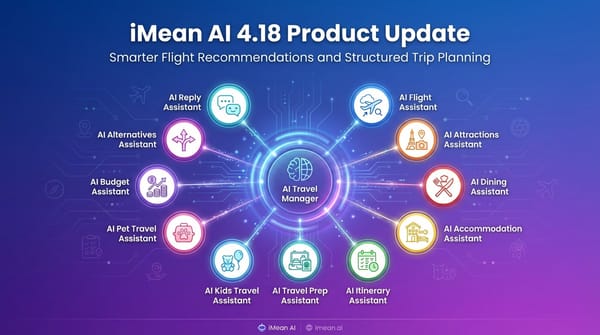
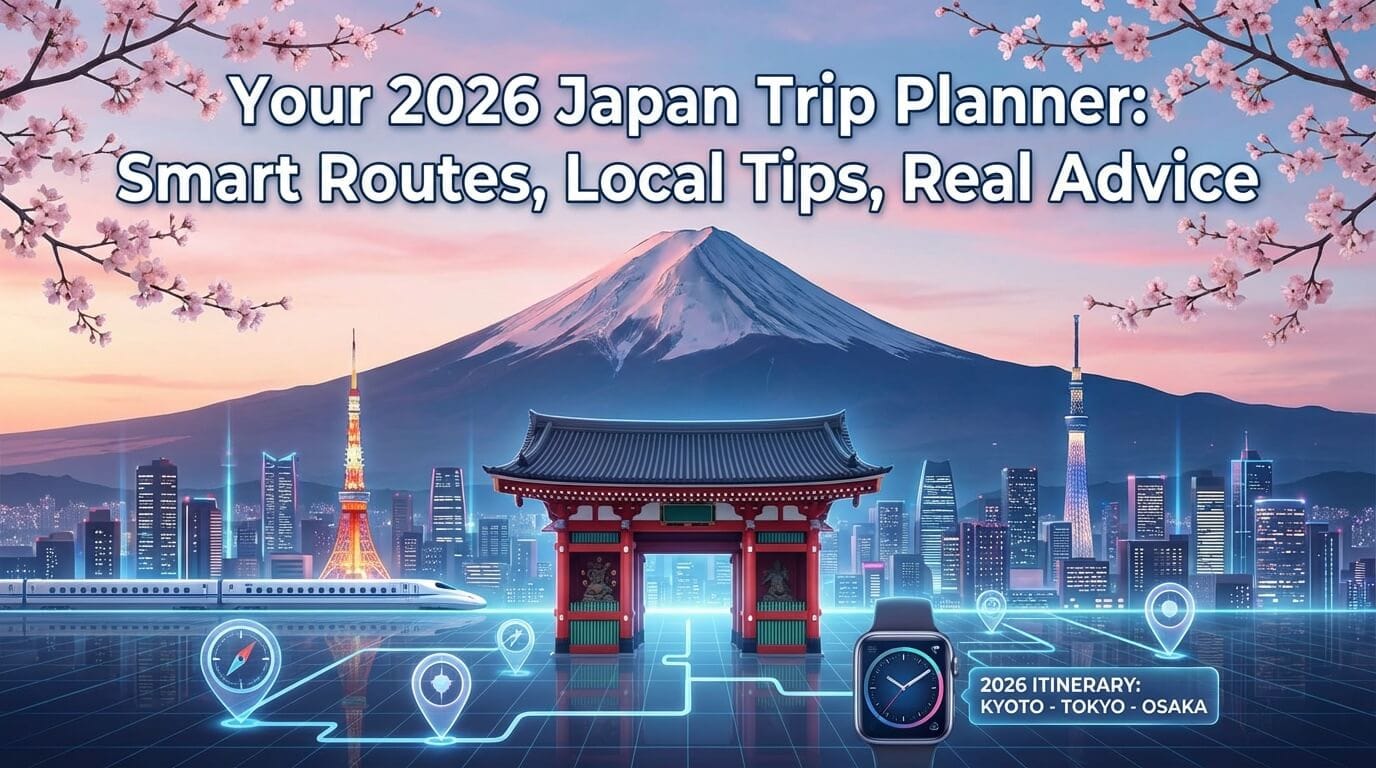
If you’re looking for a Japan trip planner that keeps things simple and actually works in real life, this guide will walk you through everything you need. Planning a Japan itinerary can be challenging due to complex traffic, high reservation requirements, cultural adaptation issues, and so on. When regular trip planner websites cannot handle the problems, it's time to let the best AI trip planner, iMean AI, step in. It delivers personalized itineraries, real-time updates, and high efficiency, while regular ones are generic, update slowly, and require time-consuming manual research.
Here is the travel guide for Japan to give you all the essential information in one helpful post from my practical experiences and the help of iMean AI. Hope you find this helpful.
1.Best Time to Visit Japan
Over the past couple of years, international flights have been cheapest in Jan/Feb, and most expensive in spring (sakura) and summer (vacation season in many countries). However, hotels tend to be the cheapest during the peak summer months around July/August (hot, humid, typhoon season).
Potentially, the cheapest time of the year might be mid-January to the end of February in winter, but there are also more and more people who pick Japan for that time of the year to go skiing and enjoy onsens there.
Pretty much all seasons have something to offer, and it depends on what you want:
- Spring: Great for sakura and nice weather overall.
- Summer: Unbearably hot and humid, but lots of festivities and fireworks.
- Fall: Generally nice weather (occasional typhoons in early fall, though), nice to see the foliage color change in November.
- Winter: Xmas festivities, very nice for skiing in the "Japanese Alps", enjoying snowy scenery in Hokkaido, and a cozy onsen. By the way, locals told me the food is at its best in winter.
October and November won't be the cheapest, but they are very nice weather-wise. I’d recommend spending at least 7-10 days if doing a typical Tokyo, Osaka, and Kyoto first-timers itinerary; however, I recommend staying longer and exploring more than just these three cities.
2.How to Plan Your Trip with an AI Trip Planner
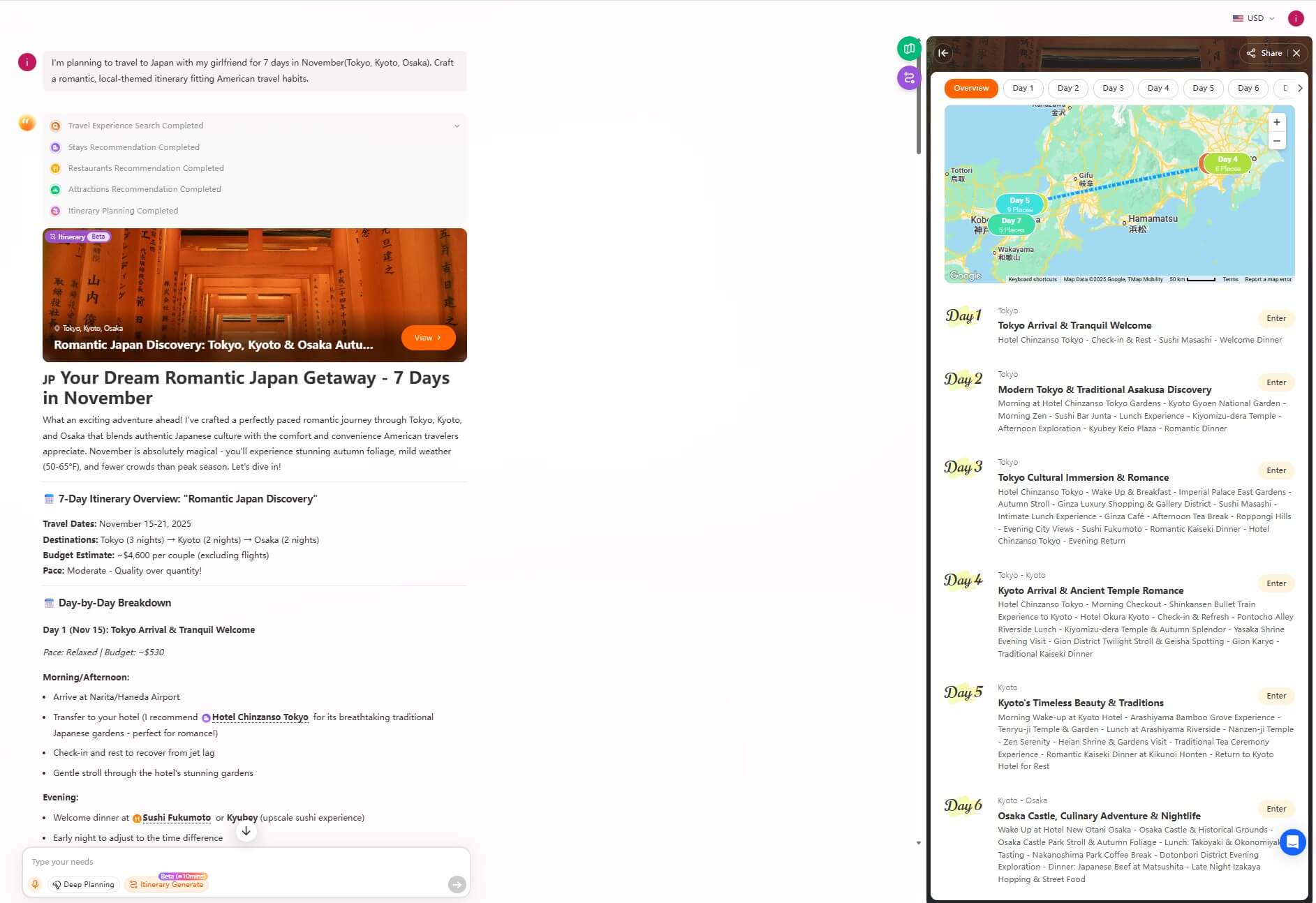
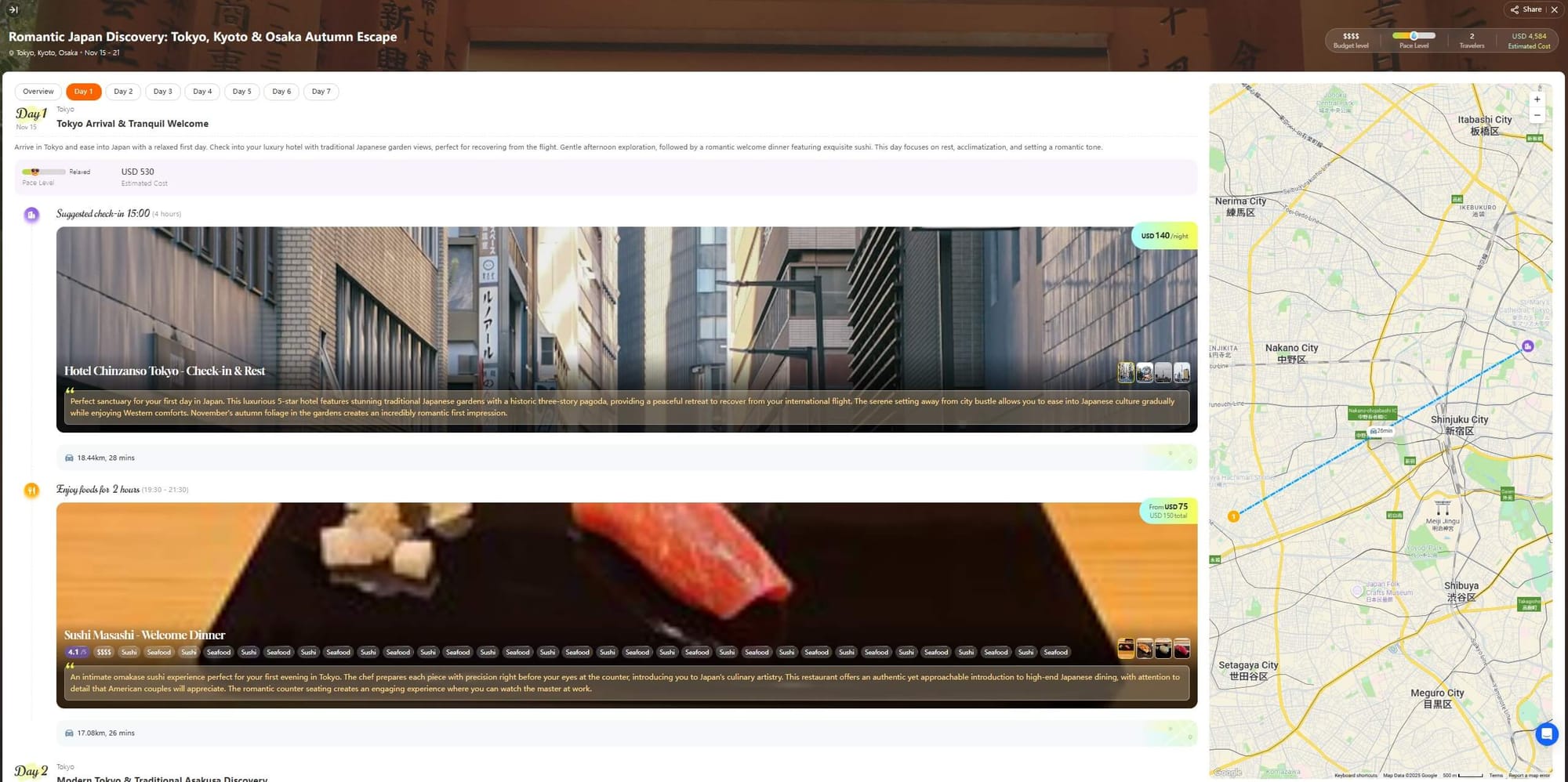
After trying different tools, I ended up keeping my planning process incredibly simple. Instead of juggling dozens of notes, I follow three steps using one AI planner to organize the details, then manually adjust based on what I want to prioritize.
Step 1: Tell the planner what you want
Type in your travel dates (or say you are flexible), how many days you want, and what you’re into, including food, temples, nature, shopping, onsen, relaxed days, or packed days. The more honest you are about my pace, the better the results.
Step 2: Let it build realistic routes and picks
This is where AI helps the most. The tool suggests a clean route that follows geography instead of bouncing around. It also recommends hotels based on price range, location, and facilities, plus flight options that match my schedule. There is no need for you to guess which neighborhood is convenient or which airport timing makes sense.
Step 3: Review, tweak, and share
Check the day-by-day plan and swap anything that doesn’t match my mood. Maybe you can move a museum to another day or replace a shopping stop with a neighborhood walk. After that, you'll get a shareable itinerary link. Through these 3 steps, I got my perfect itinerary.
3.Where to Stay in Japan
Japan’s cities have clear personalities, so choosing the right area often matters more than choosing the right hotel. Here are three solid examples from different cities.
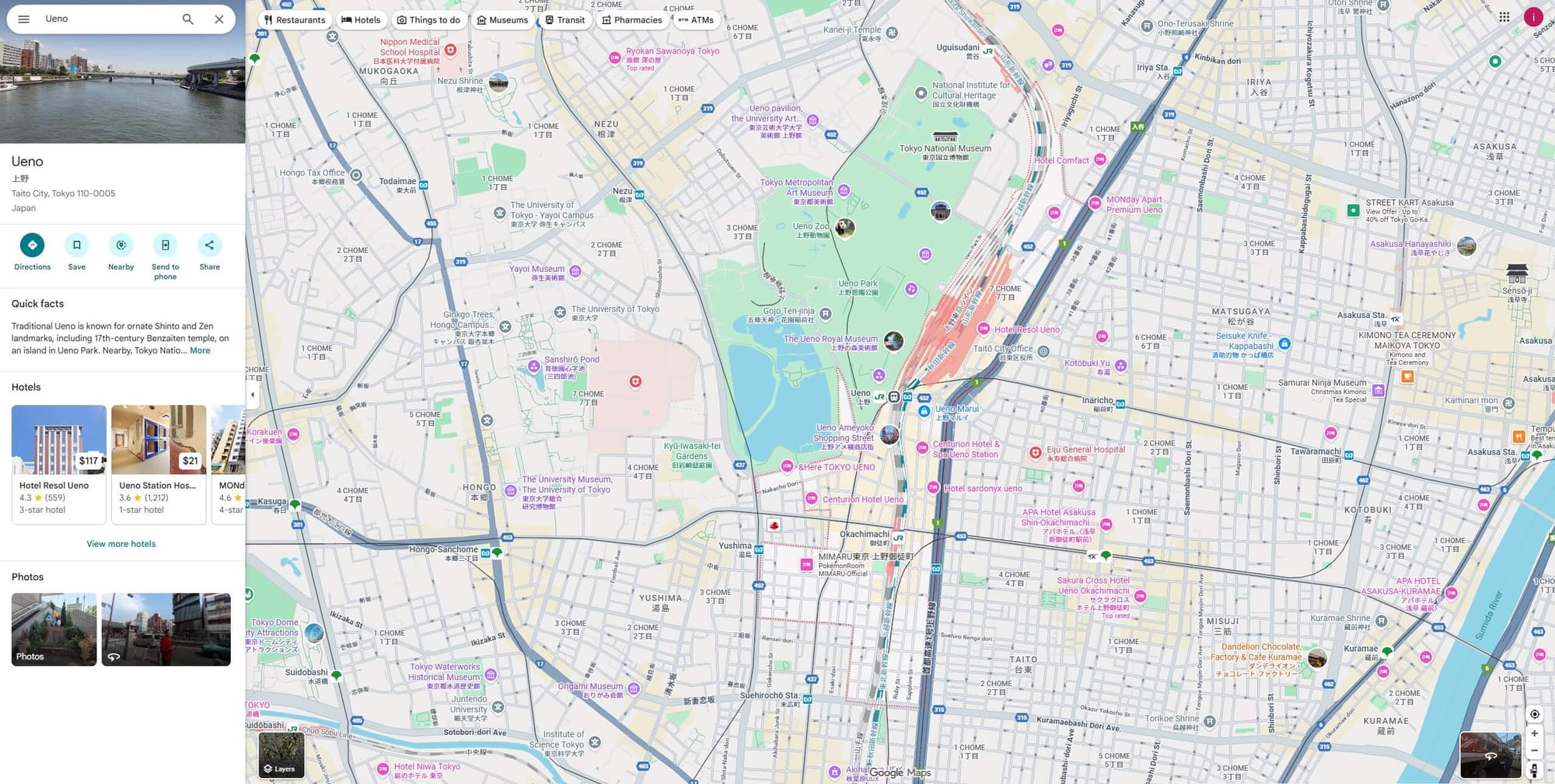
Tokyo: Ueno
It has direct access from Narita Airport via the Kaisei Skyliner. You never have to worry about transferring from one station to another while carrying luggage and bags. Within the Yamanote line, which connects to most stations of main attractions (Shinjuku, Shibuya, Meguro, etc). Akihabara and Asakusa are also on the same line, but if you're fond of walking, it's just a 30-minute walk. Asakusa near Sensoji Temple is the best and cheapest place for souvenirs.
However, near Ameyokocho market for overwhelming shops, bars, and restaurants, the area has a different vibe than the rest of Tokyo (in my opinion) with lots of drunk people, litter, people shouting, etc, which is very opposite to the Japanese culture. All in all, it's a good choice for first-timers.
Kyoto: Gion
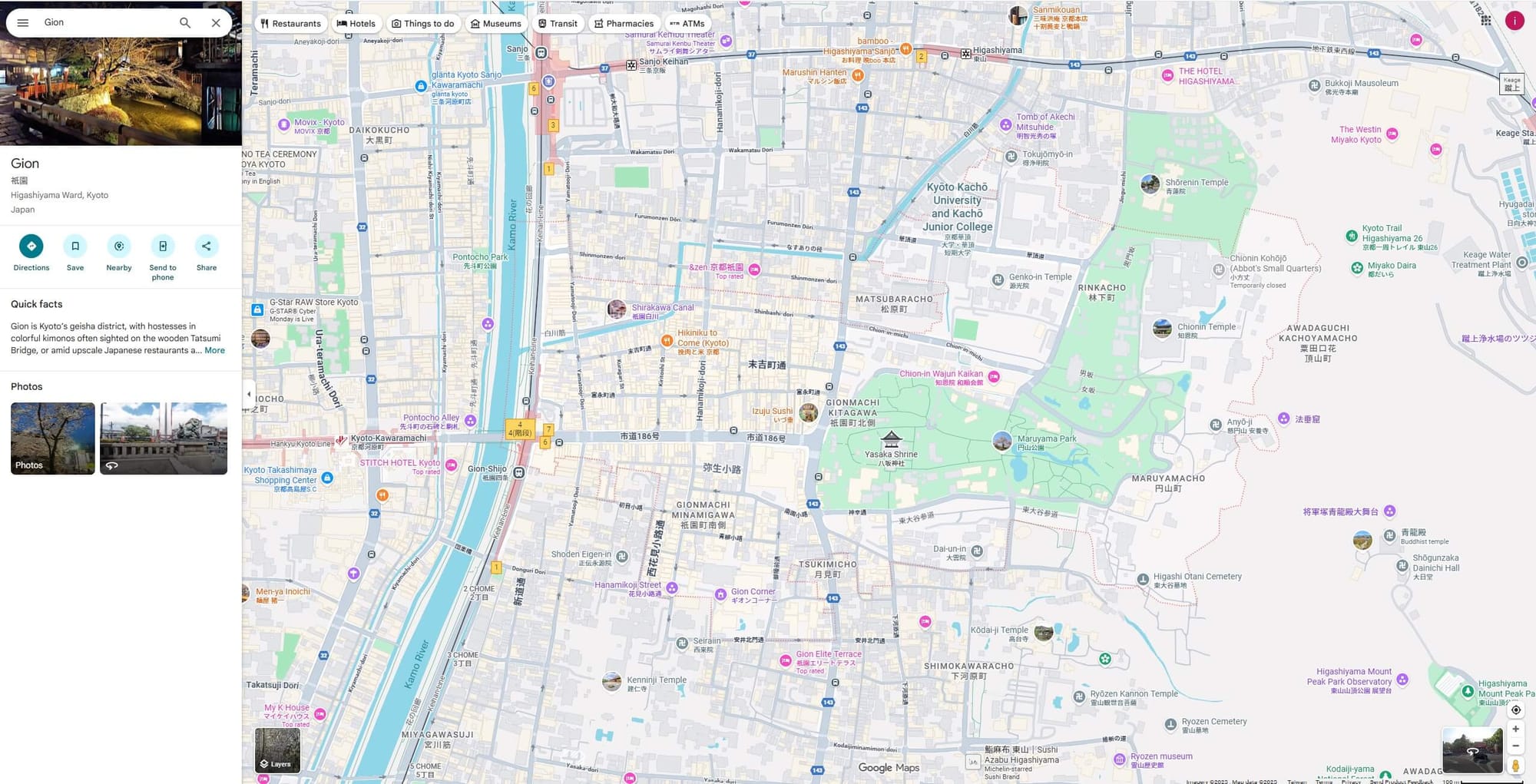
If you are culture lovers and slow-paced travelers, this is the place. Picture narrow lanes, wooden houses, temples within walking distance, and soft evening lights. It’s a taxi ride from Kyoto station, but it was beautiful, quiet (depending on the exact street you’re on, some are obviously more touristy at night), and still close enough to plenty of shrines and the hustle and bustle of other areas. It's also still near plenty of convenience stores, antique shops, restaurants, cocktail bars, and getting across the river was just a short walk away.
I do understand people suggesting Kyoto Station if you plan on doing a lot of day trips for most of your stay, but it is very nice to stay in one of the most beautiful parts of the city.
Osaka: Umeda
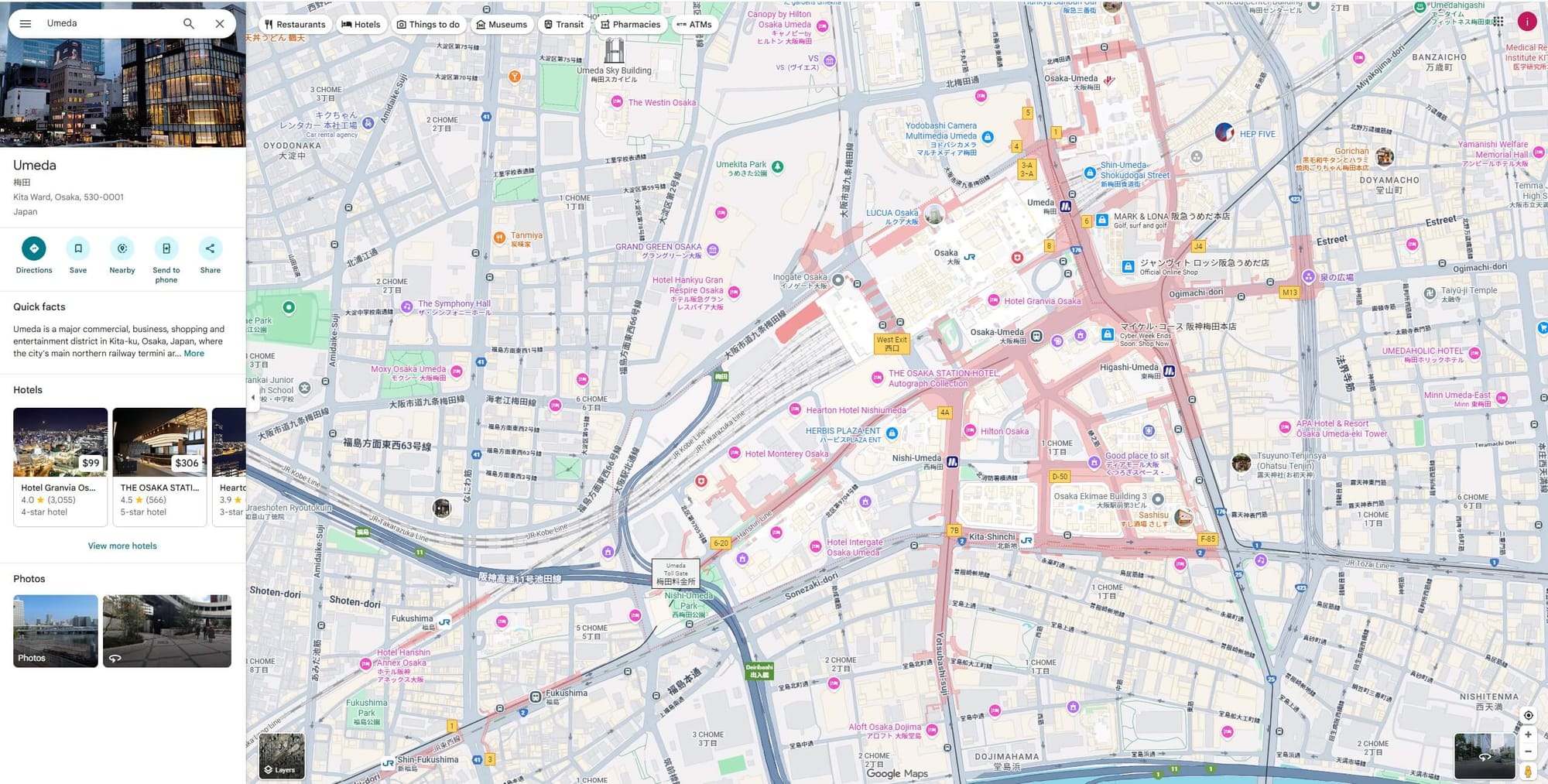
Osaka is Japan’s food capital, and Umeda puts you right in the city. This area has amazing food halls (Hankyu, etc), very interesting to see the events in the area, lots of shopping places, overall more and better food places that were aimed at locals and genuine, not tourist-focused. Additionally, it's great if you want to make day trips outside of Osaka, and Dojima, Kitashinichi, and Nakazakicho all have a decent nightlife. If you want to experience locals' lives and culture, amazing food, and captivating nightlife, choose Umeda.
4.Top Things to Do in Japan
I picked some “must-see places” in Japan. I prefer thinking in routes because the places aren’t anywhere near each other, and mixing them into the same day often leads to long transfers and stressed-out mornings. This makes the trip feel smoother and helps you avoid overstuffed days.
Route 1: Tokyo → Nikko → Hakone
If you want a mix of modern energy, nature, and hot springs, this route flows well without wasting hours in transit. You start with Tokyo’s fast-paced neighborhoods, then head into Nikko’s softer, forested atmosphere, and end in Hakone, where the day naturally slows down.
Why it works: Each stop feels like a complete shift in tone, but you’re never traveling too far.
What to keep in mind: Hakone deserves breathing room. Don’t try to squeeze it into a rushed day—you want time for the ropeway, the lake views, and the hot springs.
Route 2: Osaka → Kyoto → Nara
This is the classic Kansai loop that almost always works, especially for first-timers. Osaka gives you food, nightlife, and easy transit; Kyoto brings temples and culture; Nara adds a relaxing day with shrines and deer parks.
Why it works: Everything runs on clear train lines, and all three cities keep travel times short.
What to keep in mind: If you plan to hop around Kyoto and Nara frequently, staying close to a major Osaka station—Namba, Tennoji, or Umeda—saves a lot of time.
Route 3: Hokkaido Nature Route (Sapporo → Otaru → Furano)
Perfect for travelers who prefer open spaces over city sightseeing. Summers bring lavender fields and rolling hills; winters feel like a postcard with powder snow and cozy cafés.
Why it works: The pace is slower, the scenery is huge, and each destination feels like a different version of Hokkaido.
What to keep in mind: Public transit works, but distances are wider than most first-timers expect. Renting a car lets you explore without being restricted by bus timetables.
Route 4: Fukuoka → Nagasaki
A lesser-known but incredibly rewarding route for food lovers and travelers who’ve already done the Tokyo–Osaka loop. It’s warmer, more relaxed, and has a deeper historical feel.
Why it works: Both cities are easy to navigate and offer a mix of coastal scenery, culture, and local experiences.
What to keep in mind: Give Nagasaki an unhurried full day—there’s more to see than people assume. Japan’s transportation systems are famous for being efficient, but that doesn’t mean they’re always intuitive. What helps most is understanding the broad patterns: how to move within cities and how to connect between them.
5.Transportation Tips for Japan
Moving Within Cities
Big cities like Tokyo, Kyoto, and Osaka depend heavily on public transportation, but each uses it differently.
- Tokyo: The subway is your best friend. Nearly every neighborhood is connected by JR or metro lines, and once you understand a few major transfer stations, the city becomes surprisingly easy to navigate.
- Kyoto: Unlike Tokyo, Kyoto’s biggest sights aren’t all near subway lines. Buses fill the gaps, especially for temples in the north and east. Walking is part of the experience here, especially around Gion and the Higashiyama district.
- Osaka: Think of it as a simpler Tokyo—straightforward subway lines and fast JR connections. Great for travelers who want minimal thinking when moving around.
Car rentals only make sense in rural areas or islands. Inside major cities, they’re more hassle than help due to traffic, parking, and narrow streets.
Traveling Between Cities
- Shinkansen (bullet train): Ideal for connecting major cities—Tokyo to Osaka, Osaka to Hiroshima, Tokyo to Sendai. The trains are clean, punctual, and comfortable, and stations feel like small airports without the chaos.
- Domestic flights: Useful when cities are far apart, like Tokyo to Sapporo or Osaka to Okinawa. Most airports connect easily to local trains, so transfers are painless.
- Car rental for regional trips: If you’re exploring Hokkaido, the Japanese Alps, Tohoku countryside, or Okinawa, having your own car offers far more freedom than relying on limited bus routes.
6.Transit Cards & Passes (What You Actually Need)
You don’t need to memorize dozens of transit cards. A few basics cover almost every scenario:
- Suica / PASMO: Tap-and-go cards are used across most big cities. Once you have one, trains and buses become effortless.
- ICOCA: The Kansai-region version of Suica—great for Osaka, Kyoto, and Kobe.
- JR Pass: Helpful if you’re traveling long distances over several days. If your trip stays mostly local, you likely won’t need it.
One tip: Many travelers buy large passes because they assume they’re mandatory. In reality, Japan’s transit is already efficient and fairly priced. Passes only make sense if you’re taking multiple long routes in a short window.
Final Thoughts
Japan rewards good planning, but you don’t need to spend weeks building a perfect schedule. A clear route, the right neighborhoods, and a realistic understanding of travel times already put you far ahead of most travelers. If you want a personalized, editable day-by-day itinerary for Japan, try iMean’s free trip planner and build a version that fits your travel style, pace, and budget.